Gold prices decline after a higher-than-expected US inflation report, impacting trader sentiment ahead of the Jackson Hole symposium.
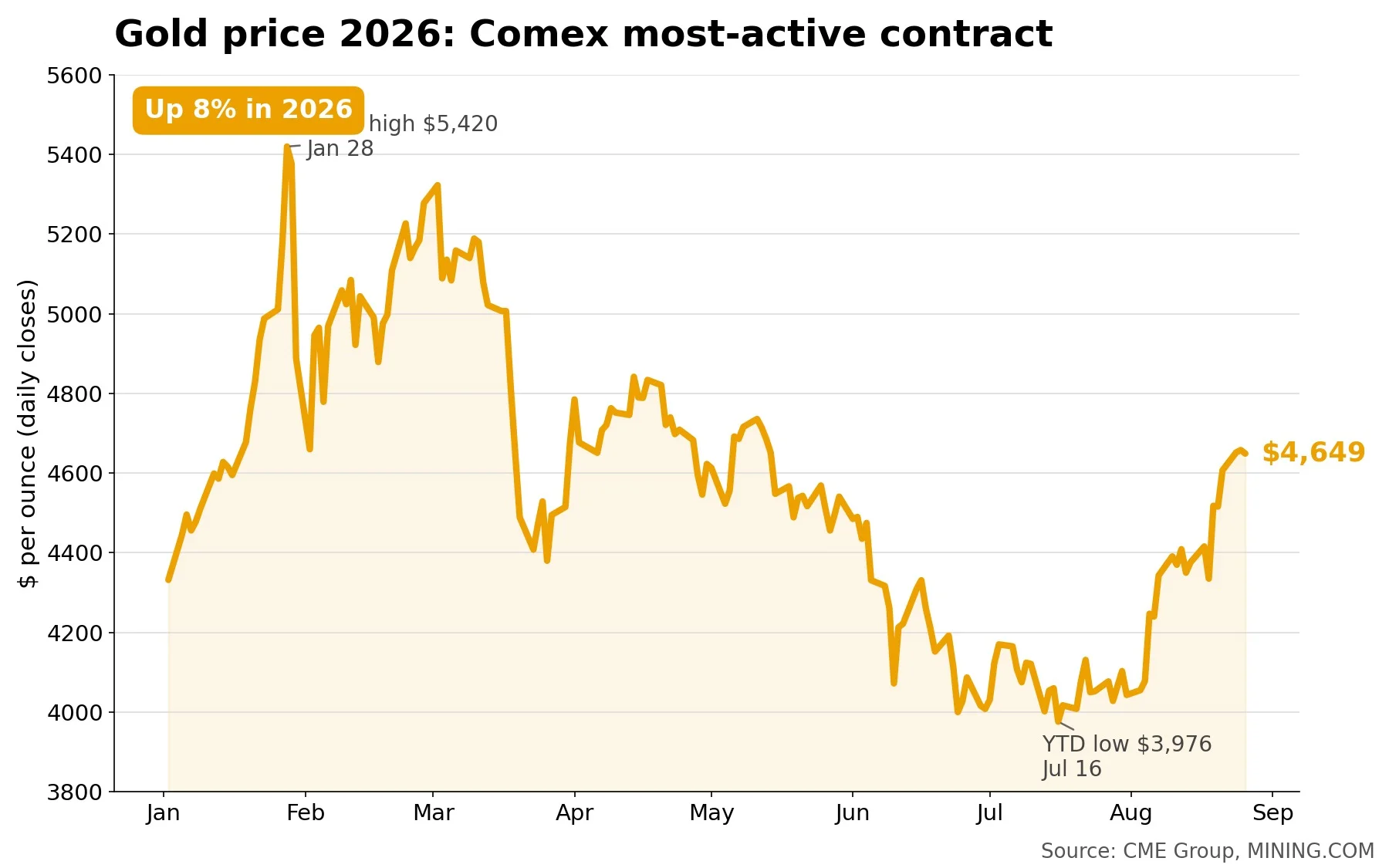
Gold prices retreated from a three-month high on Wednesday, driven by a hotter-than-anticipated U.S. inflation reading. Traders are now closely monitoring Kevin Warsh's upcoming address at the Jackson Hole symposium for insights on potential shifts in monetary policy.
The December gold contract on Comex saw a decline of 1% to $4,649.10 an ounce by late morning in New York, pulling back from a peak of $4,730.90 reached overnight. This drop follows a strong performance earlier in the week, marking the highest closing since mid-May.
Spot gold traded down 1.4% at $4,592.53, moving away from Tuesday's three-month peak. Despite this pullback, the precious metal has surged approximately 14% in August, returning above the 200-day moving average.
In tandem, silver displayed a similar pattern, with the September contract slipping 1.1% to $67.96 an ounce, while spot silver fell by 0.8% to $68.03. However, silver remains up 18% this month, helping to mitigate a nearly 5% decline for the year to date.
The decline in gold prices accelerated after the release of the Fed's preferred inflation measure. The headline Personal Consumption Expenditures (PCE) index rose 3.7% year-over-year in July, exceeding expectations by a tenth of a percentage point, while the core metric held steady at 3.3%. Meanwhile, consumer spending showed minimal growth as purchases of goods decreased, creating a tension between persistent inflation and a cooling consumer market. Increased borrowing costs typically pressure non-yielding assets like gold.
Attention now shifts to Warsh's maiden speech at the Jackson Hole symposium, where he has an opportunity to address concerns about his openness regarding economic perspectives.
Market Dynamics Amid Rising Deficits
Gold's recent rally can largely be attributed to unexpected interventions by the U.S. Treasury in the bond market. This has reignited the trend of purchasing hard assets as a hedge against increasing deficits and dollar weakness. The shift towards hard assets isn’t just a temporary reaction; it's reflective of broader economic anxieties. Earlier this week, gold-backed ETFs saw a positive response, accumulating over 28 tonnes—the largest weekly boost since January.
Analysts at TD Securities noted, “Precious metals are finding comfort in this higher range,” while pointing out that surging energy prices and ongoing inflation risks might cap short-term gains. They expressed skepticism that the current environment is ripe for a drive back toward record highs. This caution stems from the delicate balance between inflation and economic growth, indicating that while gold may find support, a strong sustained rally could face headwinds from macroeconomic pressures.
Stock Reactions in Precious Metals Sector
On a day marked by lower metal prices, gold and silver equity stocks also took a hit. By early afternoon trading, shares of Agnico Eagle, AngloGold, and Wheaton Precious Metals were down 3.7%, 4.3%, and 4.8%, respectively. This isn't just a random fluctuation; it reflects broader investor sentiment as market participants react to the most recent price movements in the metals themselves. However, it's notable that August has been exceptionally strong for many mining stocks. Eldorado Gold's stock has surged 55% since the end of July, while others like Equinox and AngloGold followed closely with gains of 53% and 49%, respectively, outperforming the 14% rise in gold and 18% in silver.
What this means for you, if you're working in this space, is that while short-term fluctuations can be painful, the longer-term health of mining stocks may be linked to the broader trajectory of gold and silver prices. Year-to-date, spot gold is up about 6%, while silver remains just under a 5% drop. The discrepancy between the metal prices and equity performance could signify investor optimism about long-term fundamentals in the precious metals sector.
Implications and Future Outlook
This current environment of fluctuating gold prices and rising inflation brings with it a set of implications that investors and analysts should consider. If inflation continues to exceed expectations, a more aggressive stance from the Federal Reserve could further undermine gold's appeal as a non-yielding asset. In certain instances, markets tend to underplay the persistence of inflation, but that doesn't seem to be the case here. There's a palpable concern that inflation may not only stabilize but could push to new heights, effectively eroding purchasing power and stimulating demand for gold as a refuge.
Here’s the thing: the interplay between rising interest rates and gold prices is fraught with uncertainty. If the Fed reacts aggressively to inflation, as many anticipate, the threat to gold's value could intensify. And yet, if economic conditions worsen, a flight to safety could drive gold prices higher in the long run despite short-term shifts.
Ultimately, these fluctuations in gold and silver prices reinforce a critical narrative: investors are increasingly on edge, and movements in the precious metals market are becoming less predictable amidst economic volatility. The broad sentiment surrounding this market is that while gains can be significant, the risks woven throughout the economic fabric cannot be ignored. (And this is the part most people overlook.) As such, maintaining a vigilant and adaptable approach will be key for those involved in trading or investing in these valuable commodities.
Discussion
Sign in to join the discussion.