The 30-year mortgage average slipped to 7.18% after a bond rally, while muted applications and forecasts above 7% cloud the 2027 housing outlook.
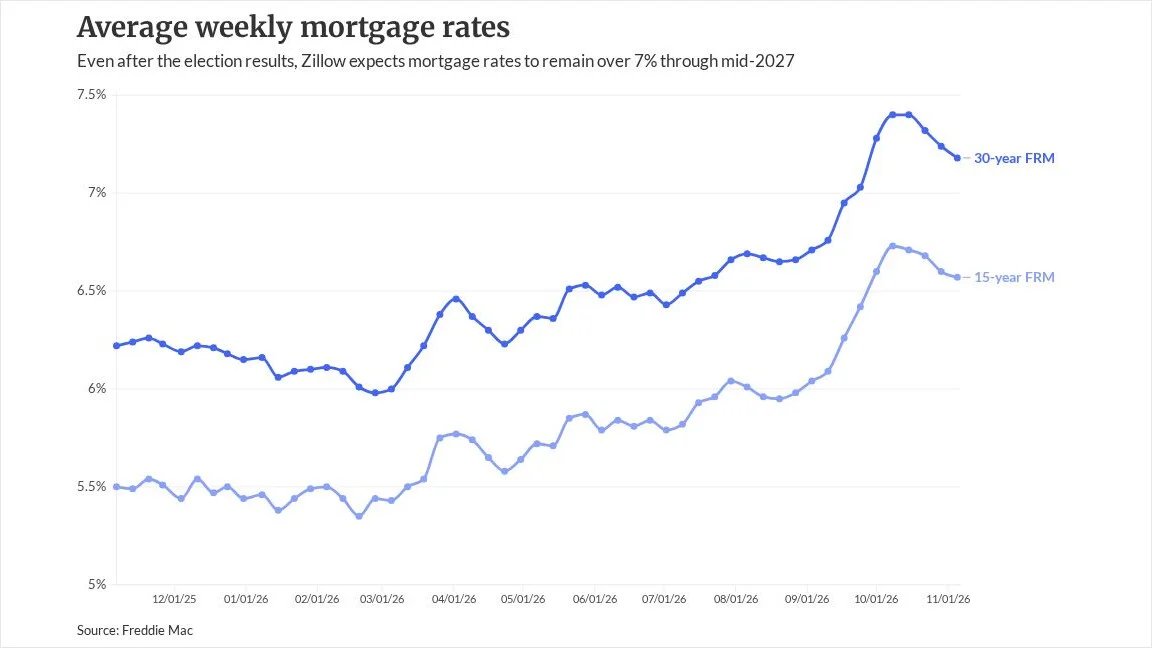
A modest bond rally has given mortgage lenders a brief opening to reengage borrowers already in their pipelines. Freddie Mac’s average 30-year fixed rate fell to 7.18% for the week ending Nov. 5, down six basis points, while the 10-year Treasury yield reached 4.83% Thursday morning after the midterm elections.
That shift has yet to translate into a clear pickup in applications. Mortgage demand often responds quickly when rates improve, but borrowers weighing affordability and economic uncertainty may need more than a short-lived dip to restart their plans.
Rates retreat, but remain elevated
The 30-year fixed rate stayed above 7% for a seventh consecutive week. Freddie Mac put it at 7.18%, compared with 7.24% the prior week and 6.22% a year earlier. Its 15-year fixed average edged down to 6.57% from 6.60%; a year ago, it stood at 5.50%.
Other rate measures showed similar movement, though their levels varied. Lender Price data cited by National Mortgage News put the 30-year fixed rate at 7.41% Thursday morning, nearly six basis points above Wednesday afternoon but 14 basis points below the prior week. Optimal Blue’s conforming 30-year tracker was 7.12% Wednesday, down from 7.17% Tuesday and 7.22% a week earlier.
“When rates move favorably, demand responds quickly,” said Kyle Bass, production business manager at Refi.com. Borrowers already in the process are better placed to respond promptly, he said, because new applicants may take longer to make decisions and complete the initial steps.
Chris Affinito, chief revenue officer at Total Mortgage, described mortgage markets as having rallied on two consecutive days after the midterms. He pointed to a flight to quality in bond trading as a factor pushing yields lower.
Affordability keeps buyers cautious
The election put housing costs back in focus, but lower financing costs alone may not overcome the pressure on household budgets. “Mortgage rates are not abstract to a family trying to buy a home,” said Danielle Hale, chief economist at Realtor.com. “They show up as the home they can no longer afford.”
Hale said the year-over-year rise in home prices helped make affordability a pocketbook issue for voters. She also cited inflationary effects from the Iran conflict as a source of uncertainty, with households feeling the impact in monthly expenses and in the homes they can consider.
Zillow Home Loans expects mortgage rates to remain above 7% through the middle of next year. Senior economist Kara Ng said oil prices had fallen as markets anticipated easing geopolitical tensions, while investors were also assessing possible limits on data center construction.
Ng said it remains unclear whether the forces keeping bond yields elevated will fade sustainably. She cited government deficits, geopolitical pressures on prices and corporate borrowing to finance artificial intelligence spending. If rates stay above 7%, she expects a “chillier 2027 spring home shopping season.”
Selma Hepp, chief economist at Cotality, also expects higher rates to constrain home purchases next year, but sees support from housing supply and buyer negotiating power. More inventory could temper home price growth and improve affordability, she said, with activity likely to favor areas offering solid economic prospects, appeal to retirees and relatively affordable homes.
Treasury moves and demand signals
The 10-year Treasury yield, a benchmark used in pricing 30-year fixed mortgages, was 4.83% at 11 a.m. Thursday, six basis points below Wednesday’s close. It had remained below 5% since Oct. 22, when investors began shifting toward Treasurys amid concerns about debt issued by artificial intelligence companies, although daily highs approached or exceeded that level through Oct. 29.
Nigel Green, CEO of deVere Group, said a selloff in AI company shares could deepen as investors account for the energy and financing costs of building out the sector. For mortgage markets, the broader question is whether Treasury yields can keep easing enough to give lenders room to lower rates.
Bass said a falling 10-year yield can create that room, even when the move has little immediate effect on Freddie Mac’s weekly average. In his view, borrowers waiting on the sidelines are more likely to reenter the discussion when rates move lower, making lender follow-up with in-process customers especially relevant during short market windows.
Applications show no immediate rebound
The Mortgage Bankers Association’s Market Composite Index declined 1.2% on a seasonally adjusted basis for the week ended Oct. 30, before Election Day. The conforming 30-year rate in the survey fell seven basis points to 7.30%, but purchase applications dropped 2% and refinancing activity was flat.
“Prospective borrowers may be holding off decisions until rates and economic and political conditions settle,” MBA President and CEO Bob Broeksmit said Thursday.
The latest dip offers lenders a chance to reconnect with qualified borrowers, but the application data underline the limits of a brief rate move. Whether lower yields produce sustained activity will depend on how long the improvement lasts and whether home costs and economic uncertainty continue to outweigh the savings.
Discussion
Sign in to join the discussion.