Banks again top JD Power's 2026 originator satisfaction rankings, with Chase at 789. Rocket and Movement tied for fourth overall among nonbanks.
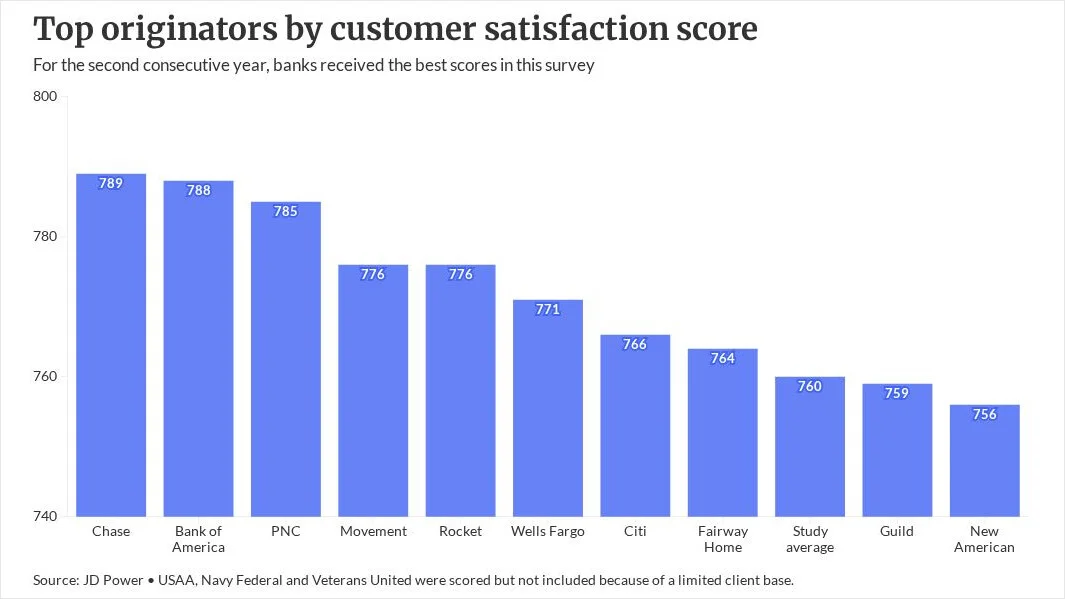
Banks took the top three spots again in JD Power's 2026 Mortgage Origination Satisfaction Study, and the edge looks like it comes from the relationships borrowers already have with their bank. For a second straight year, that advantage shows up in the scores. Digital tools are lifting satisfaction across the board, but banks seem to be getting extra credit because those tools sit on top of a relationship borrowers already trust.
The findings line up with JD Power's Mortgage Servicer Digital Experience study released in October, which also found banks scoring higher than the nonbanks it graded. Two studies pointing the same way is a signal worth paying attention to.
Why existing relationships carry weight
The biggest factor in the banks' favor appears to be the number of products a customer holds with them. Borrowers with several accounts at one institution tend to see the bank as a known quantity when they start shopping for a mortgage.
Bruce Gehrke, senior director of wealth and lending intelligence at JD Power, put it this way: "Digital is such a big part of the experience now, but it's also relationship based." In his view, that combination creates a trust component that favors banks.
He described how the trust builds. "I open up a checking and savings account or other accounts with a financial institution," he said. "It takes a certain level of trust to do that, and it's not as big of a jump then to go for a loan as it would be to a completely unknown lender."
That dynamic shows up most clearly among younger borrowers. Across the full sample, though, some respondents still see going to a new lender for a mortgage as the riskier choice. Nonbanks have to overcome that instinct, and digital polish alone doesn't do it.
Who led the rankings
Chase posted the top score at 789, up 18 points from 771 a year earlier. The bank also led JD Power's servicer satisfaction survey released over the summer, so its strength runs across both sides of the mortgage relationship.
Bank of America held second place, but its score slipped to 788 from 792. PNC rounded out the top three at 785. A year ago it scored 721 and sat third from the bottom, so that is the biggest move among the leaders.
Movement Mortgage and Rocket tied for fourth at 776. Movement's score didn't change from last year, when it was the highest-scoring independent mortgage banker. Rocket climbed from 762. Those two results are the clearest evidence that nonbanks can compete on satisfaction, even if they trail the big banks at the top.
Citi's drop stands out. The bank was the only originator above 800 last year, at 802, but it fell to 766 this year. That's a sharp reversal for a lender that set the bar in the previous survey, and it's a reminder that these rankings can move quickly.
The industry average came in at 760, flat with last year's findings. JD Power saw gains in digital channels and lender staff ratings held up, but those gains were offset by weaker scores for the trust lenders built and for how well they kept borrowers informed during origination.
What moved the needle this year
Gehrke admitted he expected a pullback. "I expected it to fall back a little, given the extra challenges we've seen this year, just financially certainly in the housing industry, and after such a large gain last year, where the majority of almost every lender was up and some really significantly," he said.
The survey found that some of the friction in the process is disappearing. Documents now move directly from the source to the lender, instead of being emailed or copied by hand. That's a small change on paper, but it removes a step that borrowers routinely cite as a frustration.
Lower origination volume may have helped. With fewer loans in the pipeline, lenders have more capacity to address process problems like these. If volume picks up, that breathing room could shrink quickly, which makes the gains here worth watching.
Gehrke also pointed to the broader comparison. "Some of the satisfaction indexes that we see in this study are higher than any other financial study that we have out there right now," he said. "So of all things in this environment, the mortgage origination process is really delivering."
He credited competition for much of that progress. "Competition drives improvement," he said. In a market where lenders keep fighting for the same borrowers, that pressure is pushing service quality up even while volume stays soft.
Where the numbers slipped
Not every metric moved in the right direction. Only 58% of respondents said they received a same-day response from their lender, down 4 percentage points from 2025. For a process that borrowers often describe as slow and paper-heavy, that's a meaningful step back.
The share of borrowers who said they had a main point of contact for their mortgage fell to 88% from 91%. That's still a healthy majority, but the trend runs in the wrong direction at the moment lenders are leaning harder on digital channels.
A larger share of borrowers also ran into problems after their loan was approved or when they reached closing. Those are the stages where a smooth digital front end can't hide weak coordination behind the scenes, and that's where lenders may need to focus next.
Younger borrowers present a different puzzle. Two-thirds of Gen Y and Gen Z mortgage borrowers preferred self-service tools for getting a loan. Yet almost half of that same group said they wished their representative had been more involved. They want the convenience of digital tools, but they also want a person available when things get complicated.
Gehrke pointed to other research showing Chime opening more new checking accounts than traditional banks. He read that as a sign that younger generations aren't as tied to legacy institutions as older customers are. That's a warning for banks that have relied on inertia, and an opening for fintech-style lenders that can earn a first relationship.
JD Power also found these borrowers are much more likely to shop around, to the point that they use artificial intelligence tools when researching mortgage providers. That raises the bar for lenders, which now have to meet both expectations at once: fast digital service and accessible human guidance.
Gehrke also noted a tradeoff in the business model. Banks benefit from having multiple business lines, which spreads risk and gives them a steadier base. But he said they are not as willing to commit to residential real estate finance as an independent mortgage banker whose primary or only business is home lending. That focus may explain some of the nonbank gains.
He returned to the competition theme in closing. "Competition drives better experiences for everybody," he said, and the data shows it "bumping down the negatives in the housing industry right now."
How other lenders scored
Three lenders that focus on veterans received scores but were not eligible for ranking because they don't meet JD Power's criteria. USAA scored 823, and Navy Federal posted 795, which would put it ahead of Chase. Veterans United scored 787, which would have placed it behind Bank of America.
At the bottom of the list, Pennymac posted the lowest score among the 17 originators ranked this year, at 696. It wasn't ranked in 2025, so there's no year-over-year comparison to show whether it improved or slipped. Freedom Mortgage, also unranked last year, scored 706.
loanDepot received a 710, down from 722. Truist moved the other way, rising to 727 from 709 in 2025.
Mr. Cooper was last year's lowest scorer among the 25 originators on that list, at 697. Rocket completed its acquisition of Mr. Cooper on Oct. 1, 2025, so that brand's score will matter to Rocket's satisfaction numbers going forward.
The bigger question for next year is whether lenders can keep the digital gains while closing the service gaps around same-day responses, contact continuity, and closing-stage problems. Banks have the relationship advantage, but nonbanks are proving they can close the distance. The lenders that fix the human side of the process first will likely be the ones that move up the rankings.
Discussion
Sign in to join the discussion.