


Listen to the audio version of this article (generated by AI).
Editor’s Note: The recent selloff serves as a reminder: Long-term trends in AI remain solid, but short-term market movements can create opportunities to reassess your portfolio.
Luke Lango elaborates on why the drop in token prices doesn't indicate a decrease in AI demand. Instead, the increasing affordability and efficiency of AI technologies are fostering heightened usage, potentially leading to the next significant market surge.
Your task isn’t just finding attractive AI investments; it's also crucial to evaluate your allocations and how resilient these investments are during downturns.
That’s why Eric, Luke, and I have meticulously restructured the AI Revolution Portfolio to include around 20 selected stocks, each with tailored allocation strategies. This portfolio is now available for viewing.
Click here to watch our full presentation and see how the portfolio was built.
Now, here's Luke to explain why the recent downturn could expose a more substantial opportunity in AI...
*********************
In 1865, an economist, William Stanley Jevons, gained notoriety for a bold claim that ultimately misjudged the impact of enhanced steam engine efficiency on coal consumption.
Engineers had improved steam technology, leading to less coal burning. Yet, Jevons countered, stating that efficient fuel use doesn’t mean lower consumption, but rather the opposite.
This claim turned out to be quite prescient.
Improved steam power didn’t diminish coal use; it actually fueled a surge in demand. Economists later framed this phenomenon as the Jevons paradox.
What’s the relevance today with soaring oil prices and Walmart's cautious consumer outlook?
Surprisingly, the same misconceptions prevalent back then are resurfacing within the AI sector. Investors who see beyond the headlines are positioned to capitalize on upcoming opportunities.
Understanding Market Volatility
Political rhetoric, such as President Trump’s declaration of an “Economic D-Day” against Iran, can disrupt market stability, causing oil prices to rise and reshaping Treasury yield dynamics.
Additionally, Walmart’s recent earnings report revealed a slower growth in comparable sales, just 2.6%, falling short of expectations that hovered around 3.8%. When household finances tighten due to rising gasoline prices, you see a shift in consumer behavior.
This is indicative of a stressed consumer base and helps explain why the recent rally in AI stocks has lost momentum.
However, the narrative surrounding the recent selloff isn’t as straightforward as it appears—here's where most investors get it wrong.
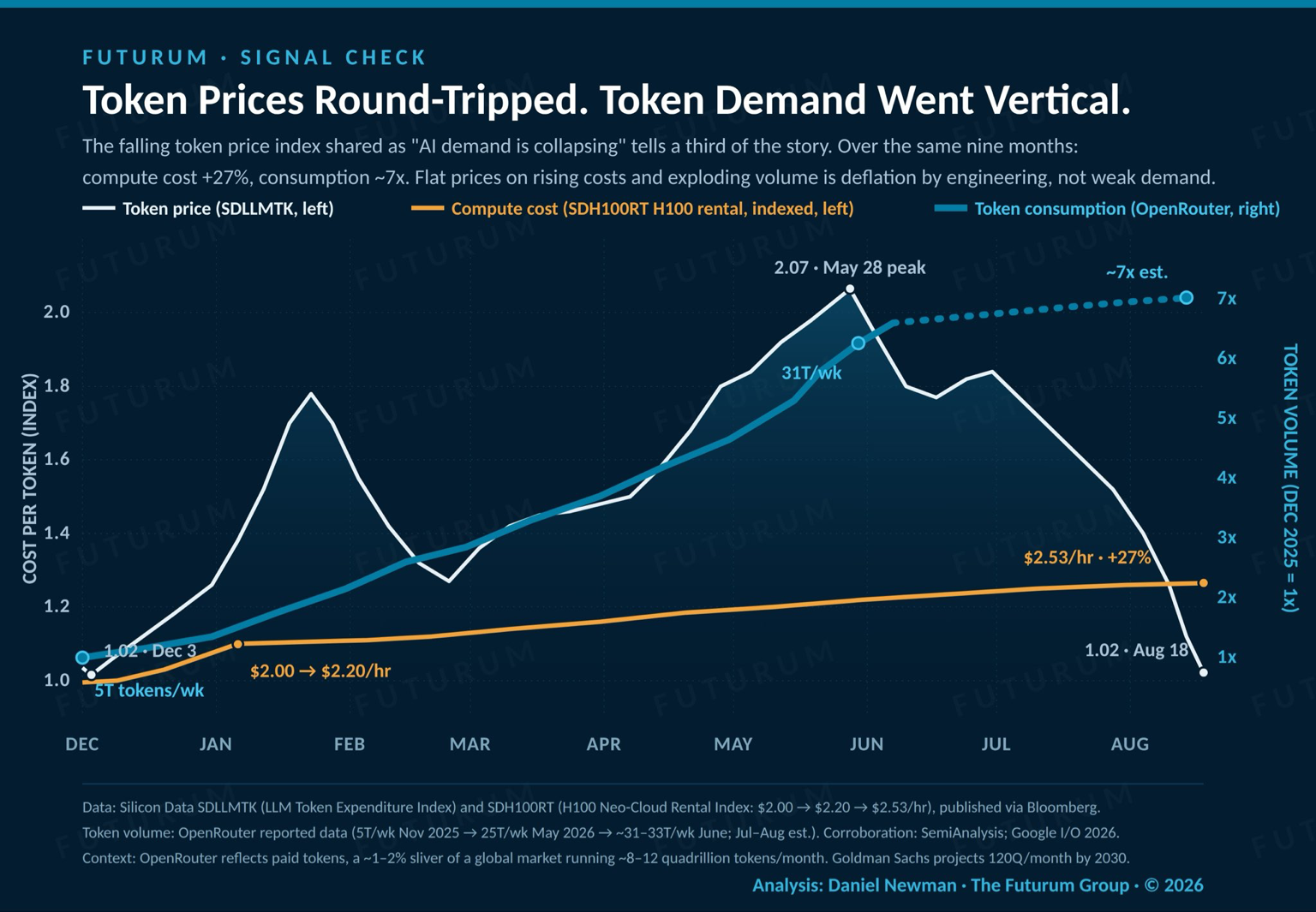
Some bears are touting a chart showing the decline of AI token prices from a peak of 2.07 in May to about 1.02 now, suggesting that this indicates waning AI demand. If we take that at face value, it might imply that interest in AI technologies is declining.
But here's what those numbers don’t show.
Throughout that same period, the cost of renting H100 compute power increased by 27%, from $2.00 to $2.53 per hour, indicating that capacity is becoming scarcer, not cheaper. Simultaneously, token usage skyrocketed: OpenRouter's demand surged from approximately 5 trillion tokens weekly last November to an estimated 31 to 33 trillion this summer. Google, at I/O, reported processing over 3.2 quadrillion tokens monthly—an impressive 7x increase year-over-year.
This flat pricing amid rising wholesale costs and skyrocketing consumption doesn’t signify weak demand; rather, it demonstrates deflation driven by engineering efficiencies—providers lowering costs while encouraging heightened user engagement.
It’s the Jevons paradox materializing in real time, and OpenRouter is merely a small segment of a burgeoning token market, which Goldman Sachs predicts will reach an astonishing 120 quadrillion tokens monthly by 2030.
The Disconnect: Retail Insights vs. Tech Investments
While Walmart’s financial results illustrate how gasoline prices pressure consumers, they offer little insight into the larger tech landscape, including hyperscale capital expenditures, data center demands, or the needs for advanced optical networking. Companies like Microsoft (MSFT), Amazon (AMZN), Alphabet (GOOGL), and Meta (META) are not scaling back their AI investments based on disappointing retail sales figures.
This disconnect indicates that the current weakness in AI stocks is more about market sentiment than underlying fundamentals. Sympathy trades often present attractive opportunities.
Recent developments in the tech sector support this notion. Micron Technology Inc. (MU) recently earmarked $10 billion for a new research institution focused on cutting-edge chip technologies. CoreWeave Inc. (CRWV) secured a multi-year cloud service agreement with Hudson River Trading, featuring advanced systems. Corning Inc. (GLW) has extended its fiber supply arrangement with Zayo through 2030, enhancing support for AI infrastructure growth. Furthermore, Enovix Corp. (ENVX) is scaling its drone-battery capacity in South Korea in light of a 41% surge in demand. And Palo Alto Networks Inc. (PANW) recently penned a $1 billion partnership with NTT DATA for AI governance and cybersecurity initiatives.
We view these opportunities favorably, alongside major players like Alphabet, Meta, and Microsoft, despite the ongoing discussion surrounding Australia’s news-payment legislation.
Strategies for Investment Amidst Uncertainty
As geopolitical tensions continue to shape the economic narrative, especially regarding Iran and Washington, expect volatility in the market. A resolution may be closer than anticipated, but critical data will emerge next week with Nvidia’s earnings report, which could help clarify the fundamentals.
Just as enhanced steam power didn't constrain coal usage in 1865, the affordability of tokens isn’t diminishing AI’s potential in 2026. It’s a fuel for growth.
Ultimately, the recent selloff underscores that simply recognizing strong AI fundamentals isn’t sufficient. Days like these remind us that understanding how much of each stock you own is vital for maintaining balance during turbulent times.
That’s the main focus that Louis, Eric, and I have been refining over the past weeks, leading us to completely overhaul the AI Revolution Portfolio.
Between the three of us, we've provided over 200 buy recommendations this past year, with some performers delivering incredible returns; for instance, my Lumentum (LITE) recommendation is up 645% since last August, while Louis’ Nvidia (NVDA) holding has appreciated 375% since 2023. However, amid reports from Walmart and fluctuating oil prices, the critical question isn't merely, “What stocks am I holding?” but rather, “How resilient is my portfolio during market disruptions?”
This question can’t be answered with a single stock tip. That’s why Louis has taken on a new strategic role—to specify the AI Revolution Portfolio around approximately 20 selected stocks, each with a defined allocation strategy rather than an open-ended list.
Since its establishment, this portfolio has yielded a 106.7% return. Following the latest rebalance alone, it surged 58%, far outpacing the Nasdaq's 25% during the same period, even against the backdrop of similar market noise.
This newly revamped portfolio is live and includes our AI Revolution Position-Size Calculator, along with Eric’s report on the AI stocks that might be risky before the next dip, my analysis on the one stock I believe holds the potential for 100x returns in this market, and a recorded board meeting where we discuss every aspect of the portfolio and its rationale for inclusion.
Today’s market downturn is driven by sentiment, lacking fundamental justification. The AI Revolution Portfolio has been structured precisely for circumstances like these—distinguishing meaningful opportunities from the surrounding noise, ensuring that your positions reflect true value.
Click here to explore the AI Revolution Portfolio.
Sincerely,

Luke Lango
Editor, Hypergrowth Investing
Discussion
Sign in to join the discussion.