Preliminary September data reveals a continuing downturn in consumer sentiment, reflecting heightened inflation expectations, as revised by U.Michigan.
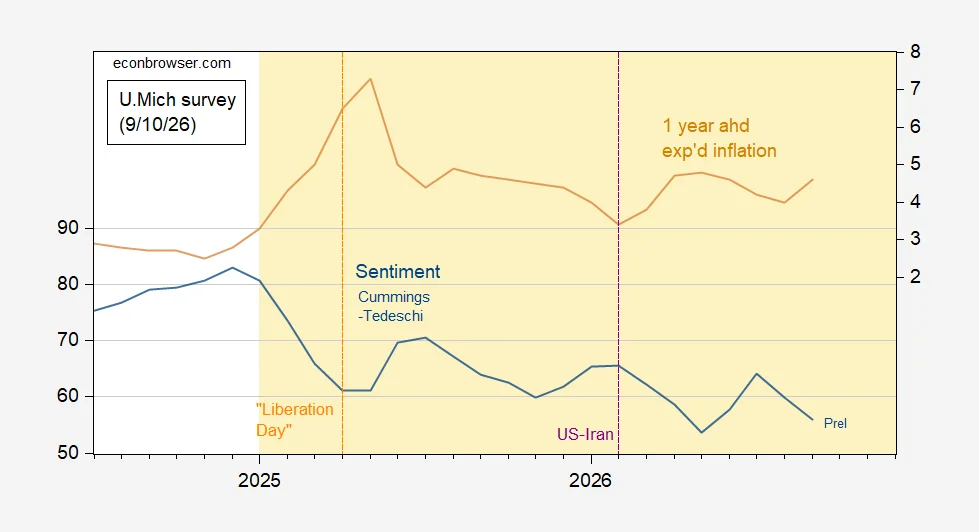
The U.Michigan survey's preliminary results for September indicate a troubling trend in consumer sentiment. Following adjustments via the Cummings-Tedeschi method, the findings position this survey between other significant measures, such as those from the Conference Board and Gallup.
A Closer Look at Consumer Sentiment Surveys
Consumer sentiment surveys are designed to gauge the public’s perception of economic conditions, personal financial situations, and overall buying trends. They serve as barometers of economic health, reflecting how households anticipate the future and how they are likely to respond in terms of spending. The U.Michigan survey is one of the most closely watched indicators in this space, alongside measures from the Conference Board and Gallup. Historically, high consumer sentiment correlates with increased consumer spending, which drives economic growth, accounting for about 70% of the U.S. economy. A decline in sentiment, however, often signals decreased consumer spending, which could lead to a slowdown in economic activity. So, when adjustments are made to these surveys—like the Cummings-Tedeschi method—it offers an evolved perspective on shifting consumer attitudes. The significance of accurately interpreting these surveys becomes clear when you consider their influence. Retailers, policymakers, and economists watch them closely, as sentiment can result in real-world economic changes. If you're working in this space, these downward trends should raise alarms about consumer behavior and potential economic headwinds.Analysis of Recent Data Trends
After analyzing the data, it appears that consumer confidence is following a downward trajectory, consistent with the trends observed in August. This reflects a broader unease among households, likely fueled by rising inflation rates, interest hikes, and global uncertainties. With consumers increasingly worried about their financial future, spending habits might tighten, a phenomenon that can have cascading impacts on the overall economy. The charts provided illustrate this sentiment visually. The first image shows the U.Michigan Consumer Sentiment alongside projected inflation expectations, revealing how interlinked expectations of inflation are to actual sentiment levels. When inflation expectations rise, consumers tend to become more pessimistic, anticipating that their purchasing power will diminish. Statistically, when consumers start believing inflation will rise, their spending today may decrease; they hold back, waiting for the perceived higher prices. This self-fulfilling prophecy can exacerbate economic slowdowns. With anxiety about future costs looming, many households are likely to cut discretionary spending—dining out, entertainment, luxury items—which can lead to business revenue declines across sectors.Comparative Framework: Other Economic Confidence Measures
To contextualize the U.Michigan results, analyzing similar indices like those from the Conference Board and Gallup is essential. Each organization employs different methodologies, which can yield varied results. Figure 2 visually compares these consumer confidence indices, emphasizing the divergence or convergence of consumer sentiment across different measures. The Conference Board's Consumer Confidence Index is grounded in a broader demographic and data set. It includes evaluations of current economic conditions, helping to form a more rounded picture of sentiment. Meanwhile, Gallup's measure often tracks long-term trends. Observing nuances between these indices offers insight into what’s driving consumer sentiment. The movement of these lines indicates a significant hit or shift in consumer confidence. These discrepancies can reveal underlying issues or strengths in the economy—especially when one index indicates relative positivity while another shows pessimism. This variance invites questions about the reliability of individual surveys—what’s changed in methodology, sample population, or even the economic environment that could lead to such differences?Implications and Future Outlook
The downward trend in consumer sentiment is more significant than it looks. As these surveys indicate, declining consumer confidence can translate into reduced spending, which might stymie economic growth and even potentially lead to a recession if conditions worsen. In an interconnected economy, the ripple effects of stagnant consumer spending can impact job growth and lead to further reductions in economic activity. Skepticism around the reliability of consumer sentiment data is also warranted. While these surveys are essential tools, they rely on self-reported measures, which can be skewered by emotional reactions to current events. One might argue that the disparity in confidence indices suggests an irrational fear among consumers not fully reflected in economic fundamentals. These fears can be disproportionate, sometimes driven more by media narratives or misinformation than actual economic performance. Here’s the thing: consumer behavior is often dictated by psychology as much as by reality. If this trend continues, watch for policymakers to react. Expect discussions around stimulating spending, whether through fiscal measures or monetary policy adjustments. Those in real estate, retail, or other consumer-reliant businesses may preemptively make strategic shifts based on these indicators. As consumer confidence continues to linger under stress, stakeholders should prepare for a potentially rocky road ahead. The implications stretch beyond just the consumer; businesses will feel this shift, too. Reducing inventories, altering marketing strategies, and adjusting expectations for growth are all reactions we might see as businesses brace for a tightening consumer purse.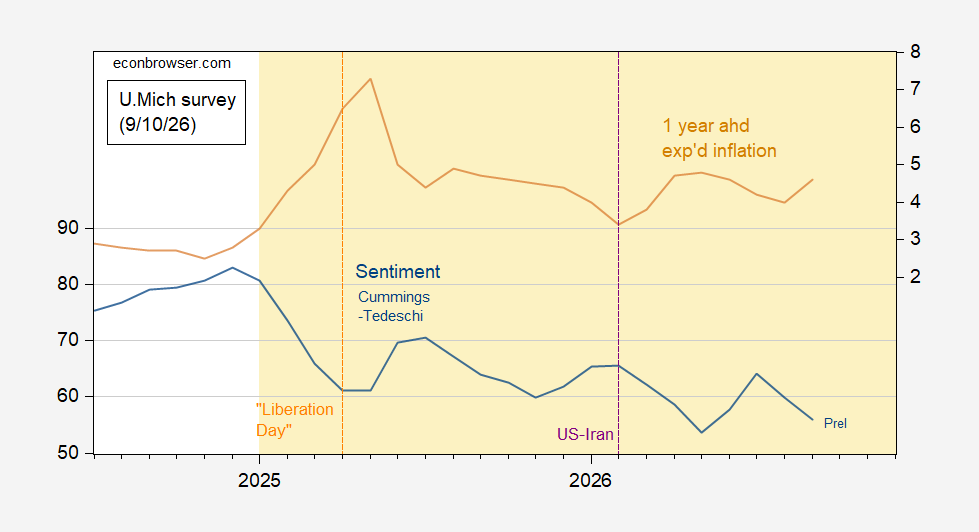
Figure 1: U.Michigan Consumer Sentiment (blue left scale), 1-year inflation expectations (brown right scale). Dashed lines indicate historical events. Source: U.Michigan, Cummings and Tedeschi (2024), author's calculations.
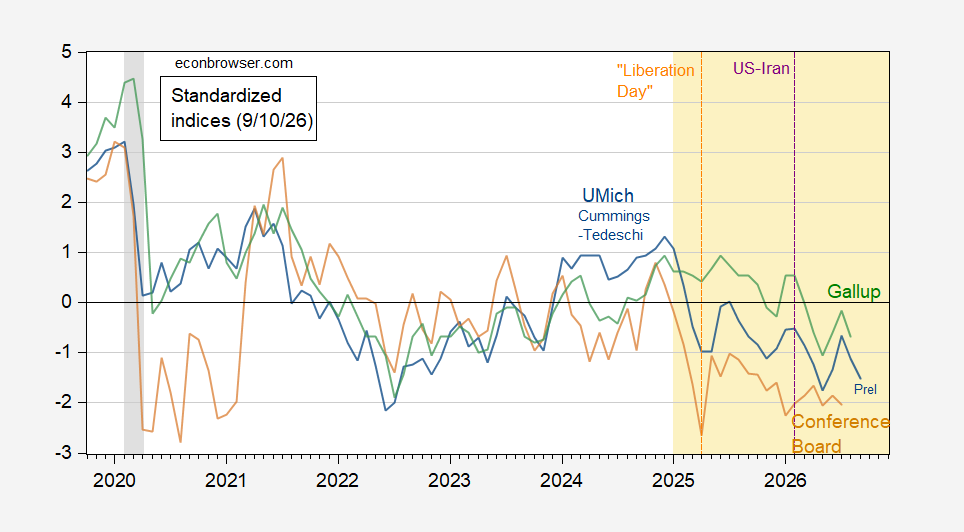
Figure 2: U.Michigan Economic Sentiment (blue), Conference Board Confidence Index (brown), Gallup Confidence (green). Source: U.Michigan, Gallup, Conference Board, Cummings and Tedeschi (2024), and author’s calculations.
Discussion
Sign in to join the discussion.