A 10% tariff on Canadian energy imports adds pressure at the pump, while services inflation and worker shortages remain concerns for Wisconsin.
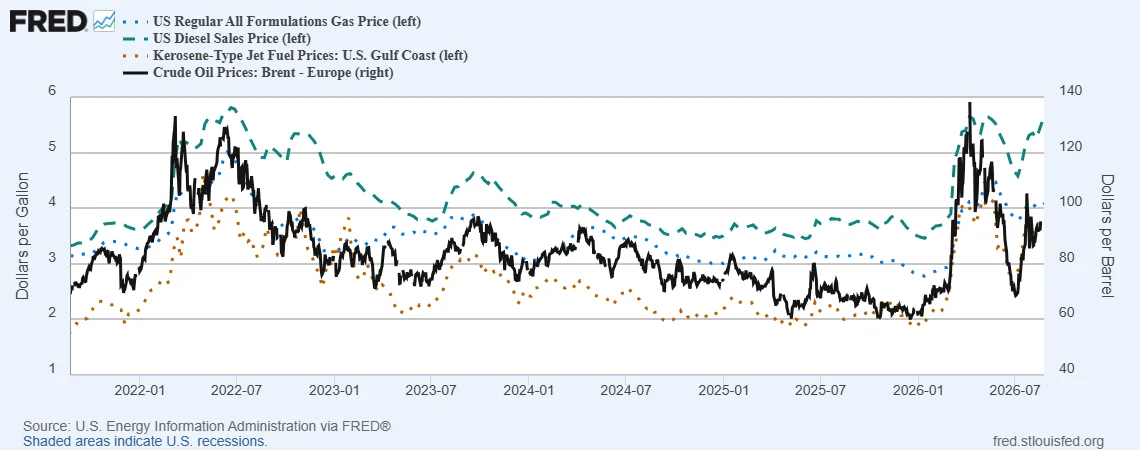
Wisconsin faces pressure on two fronts: higher fuel costs tied to tariffs on Canadian energy products and persistent services inflation amid worker shortages. The source attributes a 10% tariff on Canadian crude oil and other energy products to executive orders signed by President Trump on February 1, 2025; the tariffs took effect in early March. It criticizes Republican Tom Tiffany for supporting those orders and says Wisconsin drivers are paying more for gasoline and diesel.
Those claims describe two different kinds of pressure on household and business budgets. Fuel prices are affected by the cost of energy inputs and the way those costs pass through to buyers; services prices, by contrast, can reflect the cost and availability of workers. The distinction matters because a single inflation reading can combine forces that respond on different timelines. A change in fuel costs may be visible to drivers quickly, while staffing constraints can keep operating expenses elevated even when demand for some goods weakens.
The tariff’s stated rate and effective timing provide context for the argument, but they don't establish how much of any particular pump-price increase is attributable to it. Fuel prices can move for several reasons, and the source doesn't quantify the tariff’s contribution relative to other influences. That limitation doesn't make the issue immaterial: a policy that raises the cost of an energy input can add pressure to transportation and other fuel-intensive activities, even when the precise effect on a household’s bill isn't isolated here.
The political criticism is part of the source’s case. It connects Tiffany’s support for the orders with the added costs Wisconsin drivers are said to face. Readers should distinguish that stated criticism from the underlying price figures: the article provides a tariff rate and timing, but no before-and-after fuel-price series or estimate of the policy’s local effect. The cost concern is clear; its exact size isn't.
Spending data point to uneven demand
Core PCE inflation is reported at 3.3% year over year, 1.3 percentage points above the Federal Reserve’s 2% target. Real core-goods spending fell 0.8%, while real services spending rose 0.3%. Core services excluding energy and housing increased 0.3% month over month, a sign that services inflation remains persistent even as consumers pull back on goods.
The figures describe an uneven pattern rather than a broad retreat in spending. Real spending on core goods declined, while spending on services increased. That split can matter to businesses because goods sellers and service providers face different demand conditions and cost structures. A softer goods figure may point to consumers becoming more selective, but the services figures suggest households haven't cut every category at the same pace.
The inflation measures also answer different questions. The 3.3% figure compares core PCE inflation with its level a year earlier; the 0.3% services increase is a month-over-month change for a narrower category that excludes energy and housing. They shouldn't be treated as interchangeable readings. Taken together, though, the figures support a measured conclusion: inflation remains above the stated target, and service prices are still rising from one month to the next.
That combination complicates any simple story about cooling demand. Consumers may be spending less on real core goods while continuing to spend on services, and the costs of providing those services may remain difficult to contain where employers can't find enough workers. This is more significant than it looks: weaker goods demand alone doesn't show that cost pressure has eased across the economy.
Nor does the data prove that worker shortages caused the reported services inflation. The source presents labor availability as a contributor and points to local industries as examples, but it doesn't provide a measured estimate of the relationship. Similar service businesses typically depend on staffing to deliver what they sell; when positions are hard to fill, capacity and operating costs can both come under pressure. That's useful context, not a precise explanation of the inflation rate.
Worker availability remains a local concern
The source argues that expanding Wisconsin’s labor force among people aged 25 to 55, including through immigration, could ease services inflation. It says Tiffany supports stricter immigration enforcement, including ICE operations, and has sought to withhold federal funds from jurisdictions that limit cooperation with federal immigration authorities. The source links those positions to staffing difficulties at assisted living facilities and dairy farms. For Wisconsin businesses, the figures and examples point to a tension between cooling goods demand and continued cost pressure in services.
The policy argument rests on a practical question: whether employers can find enough people to fill the jobs their operations require. Assisted living facilities and dairy farms differ in their work, but the source uses both to illustrate how staffing concerns can reach beyond one sector. When workers are scarce, businesses may have fewer options to maintain service levels or production. In care settings, staffing can affect the ability to serve residents; on farms, labor availability can shape day-to-day operations.
Immigration policy is presented here as one possible influence on the size and availability of the workforce. The source argues that a larger labor pool, including workers who immigrate, could reduce pressure on services costs. That argument has an intuitive economic mechanism: more available workers can give employers a wider pool from which to recruit. But the article doesn't quantify how many Wisconsin jobs depend on immigrant labor, how many workers are missing, or how much a change in labor supply would affect prices. The direction of the argument is clear; the size of the effect remains unspecified.
Tiffany’s positions form the political counterpoint. According to the source, he backs stricter enforcement and has sought to restrict federal funding for jurisdictions that limit cooperation with immigration authorities. The article connects that stance to business staffing concerns, but it doesn't establish a direct measured effect from those policies on the cited facilities or farms. That distinction matters when weighing the claim: a potential pressure on labor supply is not itself proof that a specific policy caused a particular vacancy or price increase.
What the pressures could mean for Wisconsin businesses
If you're working in this space, the figures point to a two-sided cost problem. Fuel expenses may affect businesses that move goods, operate equipment, or rely on transportation. Staffing constraints can affect service providers and farms through hiring difficulty and the cost of keeping operations running. The pressures can overlap in a company’s budget, but the source doesn't offer a combined estimate of their effect on Wisconsin businesses or consumers.
For households, the distinction is familiar in practice: a driver may notice fuel costs directly, while service prices can rise more gradually as providers contend with labor and other operating expenses. For businesses, the challenge is that a decline in goods spending doesn't automatically offset higher costs elsewhere. Some companies may have less room to pass costs on to customers when demand is weakening; others may face continuing demand alongside difficulty filling shifts. The source gives no company-level examples, so those are possible dynamics rather than reported outcomes.
Here's the thing: the data support concern about persistent services inflation, but they don't settle the causes or show how long the pressure will last. The tariff claim likewise identifies a policy change and a claimed consumer consequence without isolating the policy’s share of fuel-price movements. A careful reading keeps both points in view. The evidence is enough to frame the debate, but not enough to assign every price increase to one decision or one labor policy.
And this is the part most people overlook: a softer reading in one category can coexist with pressure in another. (The source doesn't provide a forecast.) That means the Wisconsin picture described here isn't captured by goods spending alone. Fuel costs, services prices, and worker availability each tell part of the story, and the article leaves important questions about scale unanswered.
For now, the central tension is between cooling real core-goods spending and services inflation that remains persistent, alongside concerns about fuel and staffing costs. That said, the available figures don't show whether these forces will intensify, fade, or offset one another. They do show why businesses and workers may experience the economy differently depending on their exposure to energy, goods demand, and labor needs.
Discussion
Sign in to join the discussion.