The Motio Rule offers a fresh perspective on U.S. household income trends, identifying crucial patterns that signal potential recessions.
Today's discussion is led by Matías Scaglione and Romina Soria from Motio Research, an independent research firm specializing in U.S. household income analysis.
Household income plays a pivotal role in assessing economic health, yet remains conspicuously absent from the array of frequently monitored economic indicators. Conventional estimates of household income are released annually and suffer from significant delays. To address this gap, Motio Research has been publishing monthly household income estimates since December 2023, leveraging Current Population Survey (CPS) microdata extendable from March 2010 to offer timely insights.
On August 11, a new income series was introduced, closely resembling our public series but built exclusively on reported income, excluding Census-imputed values. This enhancement allows a historical comparison from January 1994, enriching our understanding of household income trends across various economic cycles.
Household-Income Momentum: A Key Indicator
This new data series captures the year-over-year percentage change in the three-month moving average of real median household income, unadjusted for seasonality. Real values are derived through the not seasonally adjusted CPI-U and the underlying CPS and CPI data are not routinely revised. We define this metric as household-income momentum.
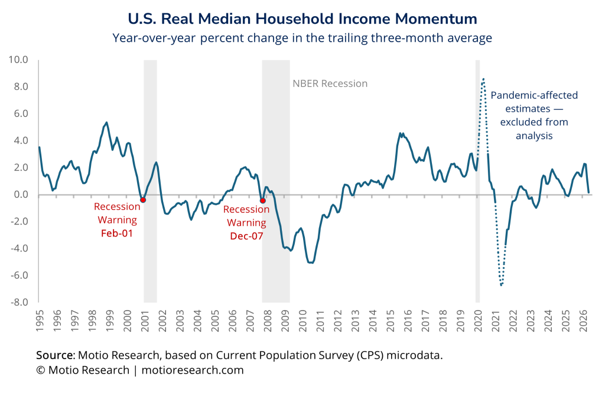
The longer historical record illustrates a definitive trend: when household income maintains positive momentum, it generally signifies economic expansion. Conversely, a decline in this momentum, especially during mature expansions, has consistently preceded recessions in 2001 and 2007-09.
The COVID-19-induced recession deviated from traditional patterns, due in part to nonresponse bias affecting CPS estimates. While such observations are included for continuity, they are excluded from our analytical warning metrics.
An interactive version of this momentum analysis can be accessed here.
Phases of the Household-Income Cycle
We categorize the household-income cycle into two established phases—expansion and contraction—along with two transitional phases—candidate expansion and candidate contraction.
A candidate expansion emerges post-confirmation of a contraction, signified by the first nonnegative momentum reading. When consecutive nonnegative results yield a minimum cumulative increase of +2.5 percentage points, it transitions to a confirmed expansion. Conversely, following a confirmed expansion, a candidate contraction initiates with the first negative reading, securing confirmation when cumulative negative readings dip to -2.5 percentage points.
Candidate phases are subject to change; if a candidate meets thresholds, the confirmed phase is retroactively dated to its commencement. If momentum reverses before achieving the threshold, the cycle remains in its last confirmed phase.
A confirmed expansion transitions to a mature phase after 24 months, assuming that at least 21 of the latest 24 momentum readings are nonnegative.
Interpreting the Motio Rule
The Motio Rule flags a recession warning when household-income momentum turns negative for two consecutive months after a mature expansion and the cumulative decline is at least 0.5 percentage points.
This warning constitutes a distinct event, rather than an ongoing condition. Each mature expansion can yield only a single Motio Rule warning.
If the conditions arise post-recession declaration by the NBER, this deterioration contributes to the household-income cycle but does not result in a Motio Rule warning.
Historical Insights: 2001 and 2007
The initial expansion confirmed in March 1995 reached maturity by February 1997. A candidate contraction emerged in January 2001, with two negative readings in February triggering a recession warning, registered one month ahead of the NBER's peak determination announced in November 2001.
After a momentary rebound in April, the cycle reverted to mature expansion, but a fresh candidate contraction took shape in March 2002, culminating in confirmed contraction status by May with a cumulative drop of 2.8 percentage points. Negative momentum persisted for 43 consecutive months.
In 2007, following a confirmed expansion in May, the cycle saw a candidate contraction in November. Similar to the previous cycle, a recession warning triggered with December's negative readings, coinciding with the NBER's peak determination later confirmed in December 2008. The contraction solidified later that year, with significant negative momentum extending for another 47 months.
Current Insights: Post-Pandemic Economic Indicators
A new candidate expansion began in July 2022, confirming itself by December with positive momentum records reaching up to 2.8 percentage points. However, a candidate contraction initiated in January 2023 was confirmed by July, preempting the expansion from reaching maturity, thus not generating a Motio Rule warning.
As of October 2023, a fresh candidate expansion was confirmed in December, maintaining stability despite a mild candidate contraction observed in April 2025, which failed to sustain past June due to positive momentum. By September, this confirmed expansion developed further, becoming mature as the cycle evolved.
As for July 2026, household-income momentum exhibited a decline to +0.17 percent from +1.1 percent in June and +2.3 percent in May. This sharp downturn, especially significant when considering traditional patterns, has drawn attention. However, unlike previous cycles in 2001 and 2007, momentum remained positive through July, indicating no new candidate contraction or Motio Rule warning.
The current data is limited, relying on two traditional recessions to develop the Motio Rule. However, the consistent trend of weakening household-income momentum prior to business-cycle peaks is a phenomenon that warrants close observation.
In summary, household income remains a key component of economic health and should be prioritized in any thorough assessment of U.S. economic cycles.
Authored by Matías Scaglione and Romina Soria.
Discussion
Sign in to join the discussion.