The 2026 rankings name top insurance employers by size, while employee survey results point to flexibility, leadership and development as retention priorities.
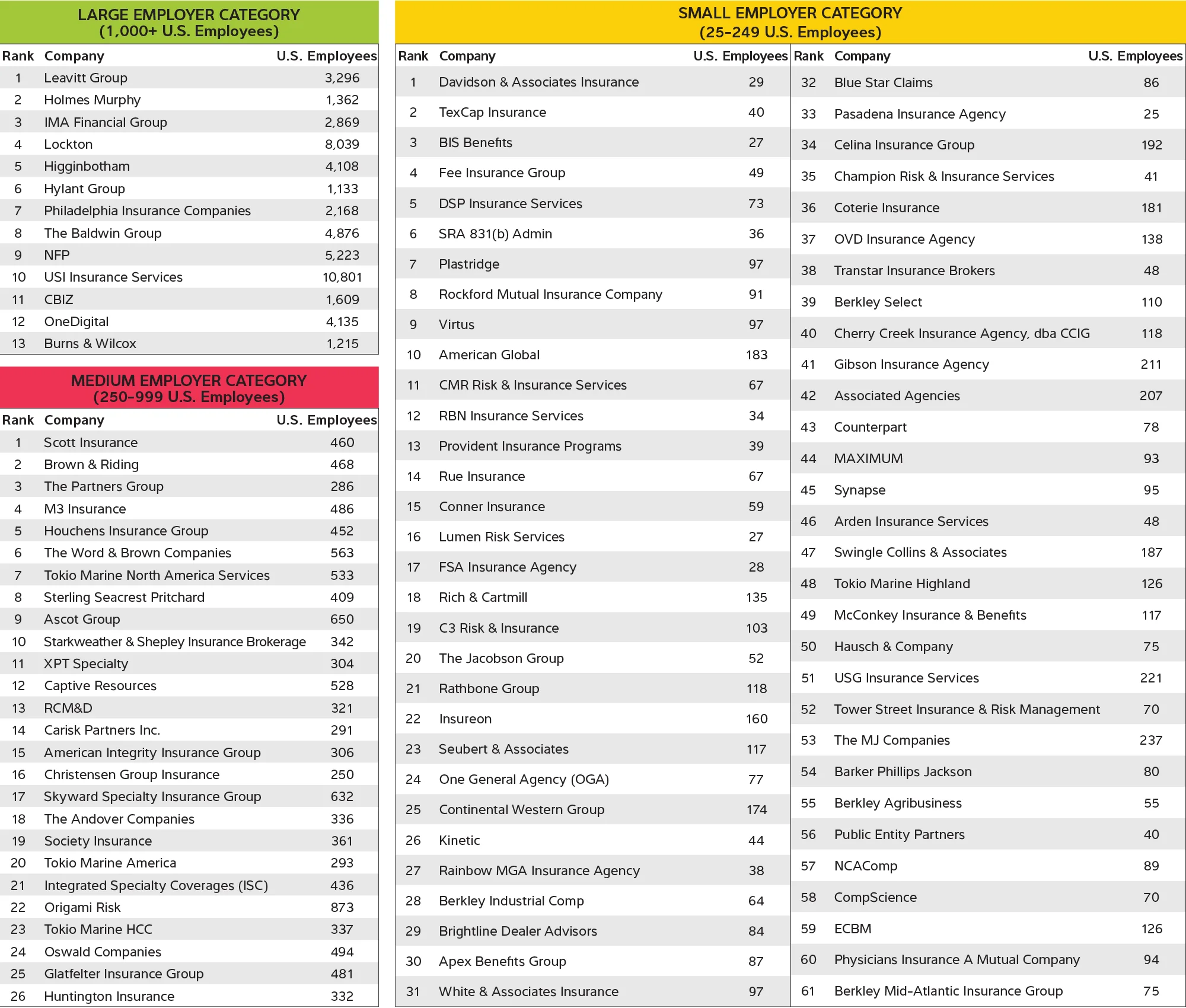
Insurance employers that ranked highly in the 2026 Best Places to Work program share a practical focus: giving employees reasons to stay. Flexibility, supportive management and development opportunities recur across the winning firms, while survey results show that the largest gaps between top-ranked and other employers involve leadership, training and workplace culture.
Presented annually by Business Insurance and Best Companies Group, the program recognizes 100 insurance organizations ranging in size from 25 employees to more than 10,000. The list spans agents, brokers, insurers and other providers. Its 2026 winners by employer size are Davidson & Associates Insurance among small employers, Scott Insurance among medium employers and Leavitt Group among large employers.
Winners reflect different approaches to employee experience
Leavitt Group, based in Cedar City, Utah, took the large-employer title. The privately held brokerage has more than 3,200 employees and operates through more than 290 locations in 31 states. It offers commercial insurance, employee benefits and personal insurance. Its structure combines national resources with local agency ownership and leadership, a model the company has maintained for more than 70 years.
Leavitt employees value a people-first culture that emphasizes flexibility, connection and professional growth. That combination matters at an organization operating across a broad geographic footprint: a shared culture has to work alongside local relationships and leadership.
Holmes Murphy, a Waukee, Iowa-based independent brokerage with more than 1,300 employees, placed second among large employers. The company provides risk management and benefits consulting across industries, and its stated workplace principle is to “love what you do and who you do it with.” Denver-based IMA Financial Group placed third. Its more than 2,800 employees value work-life balance, unlimited personal days, flexible work-from-home schedules and a social workplace.
In the medium-employer category, Scott Insurance ranked first. Founded in Lynchburg, Virginia, in 1864, the independent agency is 100% employee-owned and has more than 400 employee owners. It offers property and casualty coverage, employee benefits, captives and surety bonds. Employees cited the hybrid work program, celebrations for employee owners and company-sponsored professional development.
Dallas-based Brown & Riding, an independent wholesale brokerage owned internally by its producers and executive leadership, took second place. Its more than 400 employees value flexible schedules and extensive benefits, along with informal workplace offerings such as mid-day ping pong and cornhole breaks. The Partners Group, a Portland, Oregon-based insurance, consulting and financial services firm, ranked third. More than a third of its employees are shareholders; workplace features include fitness classes, a game room, relaxation areas and cold brew and kombucha on tap during summer.
Among small employers, Vancouver, Washington-based Davidson & Associates Insurance took first place. The independent brokerage has 29 employees and has operated under local ownership for more than 30 years. Its teams handle personal, commercial, life and benefits insurance. Employees value a pet-friendly office, work-from-home flexibility, unlimited paid time off, paid family medical leave and an annual company-sponsored beach retreat.
TexCap Insurance, a Dallas agency serving small businesses, middle-market companies and niche industries, placed second. Employees cited a supportive culture, holiday celebrations, team-building activities and volunteer opportunities. BIS Benefits, a group health and business insurance brokerage based in Roswell, Georgia, ranked third. The company offers an annual wellness stipend, unlimited paid time off and early Friday closings, reflecting its stated belief that “when we take care of our people, everything else follows.”
Category awards point to distinct workplace strengths
Rockford Mutual Insurance Company took first place in the Insurers/Providers category. The Rockford, Illinois-based insurer offers home, auto, business and farm coverage and employs 91 people. Its workplace activities include monthly events, office Olympics and a full week devoted to Customer Service Appreciation, with games, meals and prizes. Employees also value an open-door policy and casual dress.
Davidson & Associates earned another distinction as the Agents/Brokers category winner, in addition to its small-employer award. The firm recognizes birthdays and work anniversaries with gifts and holds team events twice a month, including happy hours, picnics and bowling. Employees particularly value “Fun Fridays,” which provide one paid Friday off each month.

View the Best Places to Work overall rankings (1-100) here.


Survey results put leadership and development in focus
The rankings come as insurance firms compete to recruit and retain employees amid workload pressures. A 2025 industry survey cited in the report found that 51% of independent agency employees felt burned out, 87% said their workload had increased over the prior year, and nearly four in 10 frontline employees were considering leaving their current job. Those figures help explain why the recognized companies’ emphasis on flexibility, well-being and career development is more than a set of workplace perks.
Best Companies Group assesses participating employers through two parts: a company questionnaire covering policies, practices and workforce demographics, and a confidential employee survey. Results are evaluated across eight areas. The comparison between recognized companies and those that did not make the list shows where employee perceptions separate most clearly.
Leadership and planning drew positive responses from an average of 90% of employees at top-ranked companies, compared with 76% at other firms. The measure covers employees’ understanding of company strategy, confidence in leadership and perceptions that leaders are open and attentive to well-being. For corporate culture and communication, the respective averages were 88% and 75%, covering trust, cooperation, clear communication, employee recognition and diversity.
Role satisfaction also showed a notable gap: 90% positive responses at recognized employers versus 80% elsewhere. The category includes autonomy, work-life balance and feeling valued. Training, development and resources produced an 87% positive response rate at top firms, against 73% at other companies. That measure considers onboarding and ongoing training, reliable equipment, advancement opportunities and recognition for good work.
Compensation and benefits showed a smaller difference. Positive responses averaged 85% among top employers and 79% among the rest, covering pay fairness and benefits such as vacation, sick leave, health insurance and retirement plans. Overall engagement averaged 92% at recognized firms and 81% at other employers, based on job satisfaction, purpose and pride in the company.
Some workplace factors drew relatively high ratings across both groups. Work environment responses averaged 93% at top employers and 91% elsewhere. Supervisor relationships averaged 93% and 90%, respectively, reflecting views of fairness, respect, trust and openness to feedback. The closeness of those results suggests that strong physical conditions and manager relationships alone may not distinguish leading employers as much as leadership communication and employee growth do.
How the program defines eligibility
Best Companies Group places employers into three size bands: small organizations with 25 to 249 U.S. employees, medium organizations with 250 to 999, and large employers with at least 1,000. Eligible organizations must operate in the United States, have at least 25 U.S. employees and have been in business for at least one year. Both for-profit and nonprofit organizations, whether publicly or privately held, may participate.
Eligible insurance organizations include retail agents and brokers, wholesale brokers and managing general agents, reinsurance intermediaries, claims services companies, benefits brokers and consultants, property and casualty insurers, group life and health insurers, and reinsurers. Insurance associations and service organizations aligned with the commercial insurance industry may also qualify.
The 2026 results offer employers a clear operational signal: flexible schedules and benefits help shape the employee experience, but the strongest differences in survey responses sit in leadership, communication and development. For firms facing burnout and retention pressure, those are the areas where workplace choices may have the most visible connection to employee engagement.
1 Liberty Mutual Insurance, “Burnout 2025,” accessed Aug. 11, 2026.
For information about participating in the 2027 program, contact Susan Stilwill at [email protected], call 312-636-7222 or visit www.BestPlacesToWorkIns.com.
Discussion
Sign in to join the discussion.