Zillow’s purchase originations rose 55% as industry volume fell 4%, but mortgage revenue missed analyst estimates and Q4 guidance points to a steeper market decline.
Purchase growth outpaces a contracting market
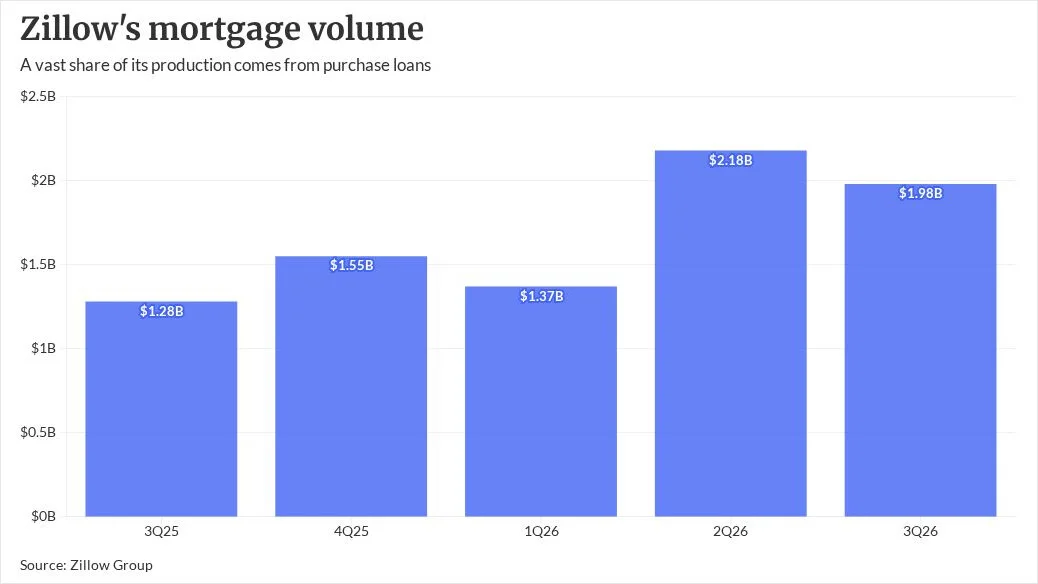
Zillow Home Loans originated $1.972 billion in purchase loans in the third quarter, up 55% from $1.276 billion a year earlier. Zillow estimates that industry purchase originations fell 4% over the same period, putting the lender’s growth well ahead of the market. Year to date, its purchase volume has climbed 79%. That gap is notable, though it doesn’t by itself show how much of the growth came from increased customer adoption, market share gains, or other changes in the business.
The growth rests on a model that connects mortgage officers with buyers referred through Zillow’s invitation-only Preferred agent network, previously known as Flex. Executives said double-digit shares of customers working with Preferred agents also use Zillow Home Loans; in the program’s oldest markets, adoption is about 20%. Those figures suggest that agent referrals can bring the mortgage business into the home search, where a buyer may be considering financing alongside an agent relationship. They don’t show how many referrals ultimately close or how the conversion rate varies across markets.
CEO Jeremy Wacksman said purchase mortgage revenue is growing faster than the category despite the industry’s decline. He argued that buyers often want an agent and mortgage in one experience, and said the company aims to build mutually beneficial relationships between its loan officers and Preferred agents. The model’s appeal is clear: a referral can put Zillow in front of a buyer already working with an agent. The test is whether that connection produces completed loans consistently, especially when rates and buyer demand are changing.
The business is almost entirely purchase-focused. Zillow originated $4 million in refinance loans in the third quarter, compared with $5 million a year earlier. In the second quarter, refinance volume was $7 million of $2.181 billion in total originations. That leaves purchase lending as the central driver of mortgage activity, making the business closely tied to home sales and the number of buyers able and willing to proceed.
Revenue falls short of analyst expectations
Strong purchase production didn’t translate into the mortgage revenue analysts had anticipated. Revenue rose 32% year over year to $70 million, below Keefe, Bruyette & Woods’ $81.3 million estimate and BTIG’s $81 million forecast. The miss shows why loan volume and revenue shouldn’t be treated as interchangeable measures: origination growth can coexist with weaker conversion or delayed closings, both of which affect when revenue is recognized.
Chief Operating and Financial Officer Jeremy Hoffman attributed the shortfall to
BTIG analyst Douglas Harter also pointed to a weakening housing market and a faster shift from Zillow’s legacy advertising business to Flex. Zillow underperformed existing-home sales for the first time since the fourth quarter of 2024, he said, contributing to weaker results across the business, including mortgage. That comparison puts the quarter’s mortgage performance in a wider operating context: changes in housing activity and in Zillow’s business mix can affect results at the same time, making it harder to attribute every shortfall to a single cause.
The revenue model changes with the referral strategy. In the advertising model, agents used lender co-marketing funds when bidding on leads, Harter said. Under Preferred, Zillow earns mortgage revenue when a loan closes, which may happen six to 12 months after the initial connection. The longer interval matters because reported revenue can lag the original referral and fluctuate with the pace of closings. (And this is the part most people overlook.) A growing pool of agent relationships may take time to show up in quarterly revenue.
Zillow reported a net loss of $158 million for the quarter, compared with net income of $10 million in the third quarter of 2025. That swing adds pressure to interpret the mortgage figures alongside the company’s broader results. The available figures don’t establish how much of the net loss came from mortgage, so it shouldn’t be read as a direct measure of the lending business alone.
Q4 outlook reflects a sharper market decline
Zillow forecast fourth-quarter mortgage revenue of $55 million to $56 million and total revenue of $635 million to $665 million. The company now expects industry purchase originations to decline 10% to 15% year over year, a steeper drop than its prior mid-single-digit estimate. Hoffman cited the sharp rise in mortgage rates late in the third quarter and at the start of the fourth. The revised market view points to a tougher setting for a business whose production is concentrated in purchase loans.
Harter said Zillow expects 20% revenue growth in the fourth quarter as it expands beyond its residential business, while mortgage revenue is projected to retreat. He estimated that the weaker housing market and a larger-than-expected transition effect cut the implied fourth-quarter revenue outlook by 8% to 9%, with headwinds likely to persist into 2027. His assessment underscores the difference between growth across the company and performance in mortgage: expansion elsewhere can support total revenue even as lending faces near-term pressure.
What the referral model needs to prove
The quarter shows the promise and the constraint in Zillow’s mortgage push: agent referrals are helping it win purchase volume, but conversion pressure and a shrinking market are weighing on revenue. This is more significant than it looks. The reported growth in originations is encouraging, yet the revenue miss and lower outlook show that strong production alone doesn’t settle whether the referral model can deliver steadier financial results.
If you’re working in this space, the useful distinction is between referral reach and closed-loan performance. Zillow’s adoption figures offer one indication of how often Preferred customers also use its lender, while quarterly revenue reflects a later point in the process. Here’s the thing: those measures answer different questions, and the delay between an introduction and a closing can make a quarter look weaker even when earlier referrals are still in progress. Timing matters.
The next measure to watch is whether Preferred adoption can keep expanding as fewer buyers enter the mortgage pipeline. Higher adoption could help Zillow capture a larger share of its own referred customers, but the company’s results remain exposed to market activity and conversion rates. And yet, the outlook leaves little room to treat volume growth as proof that those pressures have eased. The coming quarters will show whether the referral base can support revenue as the market contracts.
Discussion
Sign in to join the discussion.