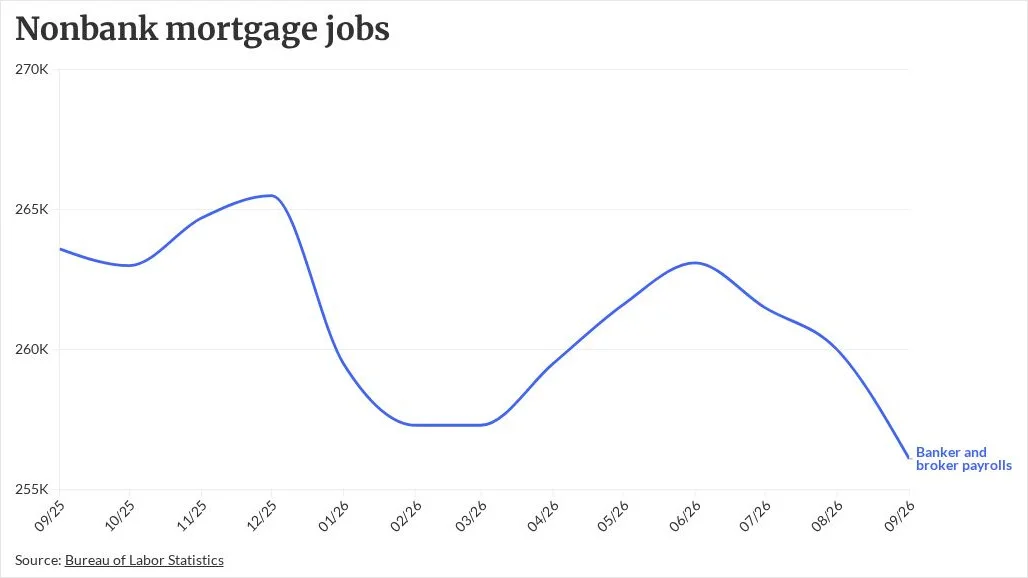
Nonbank mortgage payrolls fell to 265,100 in August as AI and leaner teams helped lenders contain costs amid a resilient jobs market.
Mortgage lenders are trimming origination teams as loan volumes remain pressured, while automation is helping employees handle more work. The adjustment has contained costs so far, but it hasn’t reduced them—a distinction that matters if rates stay elevated and demand remains soft. When fewer loans are moving through the pipeline, lenders have less revenue to absorb fixed operating costs. Higher output per employee can ease that strain, but it doesn’t establish that the underlying business has become cheaper to run.
Payrolls fall as lenders adapt
Nonbank real-estate credit and loan broker payrolls totaled 265,100 in August, according to Bureau of Labor Statistics data released with a one-month lag. That was the lowest level of 2026, after the seasonally slower first quarter. The figure captures a sector adjusting its workforce while origination activity remains constrained. Because the data arrive late, they describe recent staffing conditions rather than offering a real-time read on what lenders are doing now.
The decline came before October’s stronger employment report, which made near-term rate cuts appear less likely. Lenders have been reducing origination staffing gradually, with artificial intelligence helping loan closers manage higher workloads. That combination suggests companies are trying to match labor costs to a thinner flow of applications while preserving the capacity to process loans. Automation can help with repeatable tasks, but it doesn’t remove the need for employees to review files, resolve exceptions, and keep transactions moving.
“There are a lot of learnings that can happen in this tighter market,” said Walter Mullen, chief strategy officer at Onity, at IMN’s mortgage servicing rights conference. He said weaker origination activity has pushed companies to examine operational changes. The pressure can prompt lenders to reconsider how work is assigned and where delays occur, though the article’s data don’t show which changes will produce lasting savings. Here's the thing: a leaner team is useful only if it can handle a pickup in demand without creating new bottlenecks.
Closer output improves, costs remain flat
Mortgage Bankers Association and Stratmor Group data show that retail fulfillment productivity gains have been concentrated among closers. Their average monthly loan count rose from 36.7 per full-time equivalent employee in 2025 to 41.5 in 2026. That increase indicates that closers are processing more loans per employee, but it doesn’t by itself explain how much of the change came from automation, staffing cuts, or shifts in the mix of work. The number is a measure of output, not a full account of service quality or cost.
Processors recorded a smaller increase, while underwriting productivity edged down as origination conditions grew more difficult. Lenders attributed the gains to a combination of AI and reduced staffing. The result has been cost containment, rather than lower operating expenses. This is more significant than it looks: productivity can rise even as total costs stay flat if other expenses or the complexity of each file offset labor savings. (And this is the part most people overlook.) A higher loan count per closer doesn’t tell readers whether the broader operation is becoming more efficient at the same pace.
For lenders, the uneven results matter. Closing work appears to be absorbing more volume per employee, while underwriting has not shown the same improvement. That gap may reflect the different demands of each function; underwriting often depends on assessing borrower and property details that aren’t easily reduced to routine processing. The source doesn’t establish the cause of the productivity decline, so it’s best read as a sign that automation and staffing changes haven’t improved every part of fulfillment equally.
Jobs strength complicates the rate outlook
October’s report showed a gain of 165,000 jobs, a decline in unemployment from 4.2% to 4.1%, and wage growth, according to First American senior economist Sam Williamson. Those figures support household income and could encourage home moves, but a firm labor market may also delay mortgage-rate relief. For housing, the same employment strength can support a buyer’s ability to qualify while keeping borrowing costs higher for longer if markets see fewer grounds for near-term rate cuts.
“For housing, stronger hiring cuts both ways. More jobs mean more income and more reasons to move, while a stronger economy could prolong the wait for mortgage-rate relief,” Williamson said in an emailed statement. The tension is straightforward: income growth can help demand, yet affordability depends on both household finances and the cost of borrowing. If you're working in this space, the employment figures offer support for potential demand, but they don’t remove the rate risk facing borrowers.
The headline unemployment rate may overstate labor-market strength for some workers. MBA Chief Economist Mike Fratantoni said part of the decline reflected people taking part-time jobs when they wanted full-time work. That qualification complicates a simple reading of the headline: a lower unemployment rate doesn’t mean every worker has the hours or earnings they want. It also leaves uncertainty about how much of the reported wage and employment strength will translate into durable purchasing power for homebuyers.
Even so, Fratantoni said resilient employment alongside inflation that remains too high could make Federal Reserve rate increases more likely. The MBA expects a hike in December and another in the first quarter of 2027. Short-term policy rates influence mortgage borrowing costs, but mortgage spreads also shape the rates homebuyers face. That said, the policy outlook alone can’t explain the mortgage rate a borrower ultimately sees; other market pricing matters too.
What the staffing shift means for lenders
For now, higher output among closers gives lenders some room to manage a difficult origination market, but flat expenses show that the gains have not yet become a broad reduction in operating costs. The evidence also points to uneven results across roles, with underwriting productivity edging down. A staffing model built around lean teams may hold up while volumes are subdued, but its value will depend on whether employees can handle more business if demand improves.
The near-term test is whether lenders can sustain productivity without adding costs as they respond to changing rates and loan demand. The source offers no basis for predicting when that shift might come. What it does show is a sector working to preserve capacity while controlling expenses—and a labor market that could support housing activity while keeping the cost of financing under pressure. For lenders, the buffer is real, but its reach remains limited.
Discussion
Sign in to join the discussion.