ARMs claimed 17% of October rate locks, the highest share since Optimal Blue began tracking in 2019, even as total lock volume fell sharply.
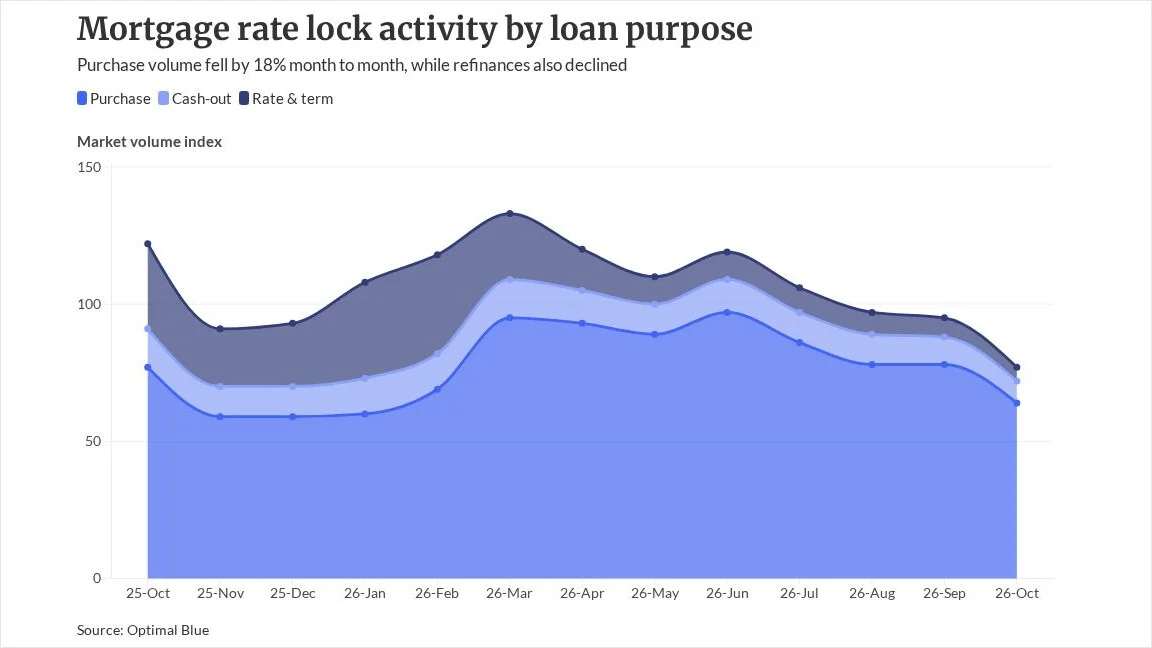
Adjustable-rate mortgages just posted their strongest showing in Optimal Blue's data series. ARMs accounted for 17% of rate locks in October, the highest share since the firm began tracking the category in 2019, according to its Market Advantage Report. That's up from 14% in September, and it happened in a month when overall lock activity was shrinking.
Here's the thing: the ARM share rose while the pie got much smaller. Total rate-lock volume fell 19% from September and 38% from a year earlier, with declines across every loan category. A bigger slice of a smaller market suggests borrowers are looking for payment relief more than they're chasing the cheapest rate on paper. Lenders have already started responding to that demand, and my read is that the shift is more than a blip.
Purchase demand softens, but the mix moves
Purchase locks made up 84% of total activity, yet purchase demand dropped 18% from the prior month and 17% from a year earlier. Optimal Blue's market volume index fell to 77 from 94 in September, a sign that the pressure hit multiple loan types at once. The broader backdrop includes ongoing macroeconomic pressures that are keeping buyers cautious.
"October's data show how much affordability is shaping the purchase market," said Brennan O'Connell, director of data solutions at Optimal Blue. "For lenders, that means the opportunity is increasingly in helping borrowers find the product and payment structure that works for their circumstances."
The composition of locks tells a similar story. FHA loans took 20% of locks and VA-backed mortgages took 11%, both up from September. Conforming loans slipped to 46% of October locks, and non-conforming fell to 22%, both down from the prior month. First-time buyers claimed 45% of conforming purchase locks, up from both the previous month and the same period last year.
Non-qualified mortgages, which have drawn more demand this year, made up 12% of October production. That's a slight dip from September but a gain of 195 basis points over three months and 420 basis points year over year. Lock volume was split roughly evenly among debt service coverage ratio, bank-statement and expanded guideline programs.
Credit availability widens, led by ARMs
The Mortgage Bankers Association's Mortgage Credit Availability Index rose 0.4% from September to 107.5, its first increase in three months. The MBA linked part of the gain to elevated ARM activity. Higher readings signal a wider range of products, and the index's benchmark of 100 reflects credit conditions in March 2012.
Lenders expanded ARM offerings for borrowers with lower loan-to-value ratios, and that included cash-out refinancing products. Government-backed credit barely moved, with the government index up just 0.1%. The conventional index climbed 0.6%, and jumbo offerings rose 0.8% month over month while conforming credit held flat.
"This also boosted the jumbo index, which was up to its highest level in three months," said Joel Kan, MBA vice president and deputy chief economist.
The pattern matches past cycles. ARM originations have historically climbed when fixed rates spike, offering buyers lower payments for at least the first few years of a loan. Those starting rates sit below the 30-year average, which is the whole pitch.
The reset risk is the part to watch
The lender upside is obvious, but the borrower side carries a catch. Research conducted in 2024 found that roughly 70% of ARM borrowers expressed regret about their choice, with some hit by sticker shock when the initial fixed term ended.
That's the real test for this cycle. If the ARM share keeps climbing, the pitch will need to be about the full payment path, not just the teaser rate. Watch whether originators build reset scenarios into those conversations, because the borrowers who understand the second act are the ones who won't be blindsided by it.
Discussion
Sign in to join the discussion.