Better signed 39 brokerages to its Tinman AI platform, replaced VP and director roles with AI agents, and targets a 40% Q4 expense cut after a $36.5M loss.
Management layers give way to AI
Better Home & Finance is moving brokerages onto its Tinman AI platform while swapping layers of its own management for AI agents. Together, those two moves could change how rivals staff their operations and compete for brokers. That's the headline, but the pairing is the real story. Platform adoption and management restructuring usually get covered separately, and here they're one strategy. Read together, they point to a lender betting that software can handle both broker-facing work and the oversight that used to sit with middle managers.
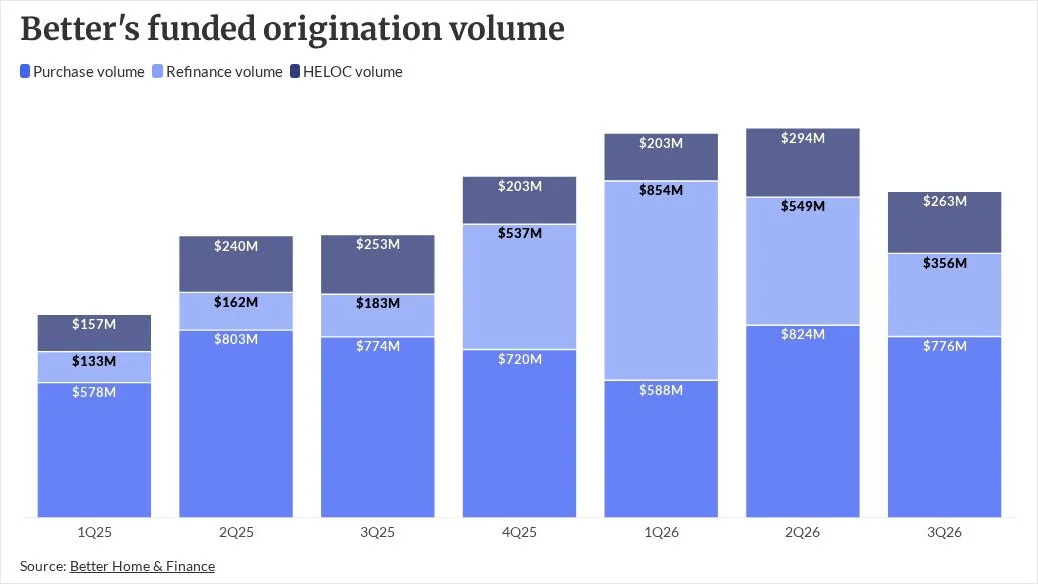
The lender has signed 39 brokerages to Tinman, starting with home equity line of credit products, executives said on Monday's earnings call. Better is also committing more to retail, even though its direct-to-consumer volume has shrunk every quarter. That's an awkward combination. Doubling down on a channel that keeps contracting is a bet that the problem is execution rather than demand. The source doesn't say which one management believes, and that gap matters. If you're watching this space, the retail push is the part to track, since it's where the numbers have been weakest.
Tinman already carries much of the business. It handled 57% of Better's loan volume, which makes it less a pilot than a core system. That matters because a platform already central to origination is harder to walk back than one still being tested. (And this is the part most people overlook.) Signing brokerages is one thing. Having them run loans through the system every day is a much deeper form of dependence, for the lender and for the brokers.
On staffing, founder Vishal Garg said the company has eliminated traditional vice president, director and senior manager roles in favor of AI agents. That's a deliberate phrasing choice. Those are the layers that usually translate strategy into daily work, so removing them means the work either moves up to executives or gets handled by software. The company hasn't detailed what replaced those people beyond the dashboards Garg describes, so the real scope is hard to judge from the outside.
Garg framed the change in plain terms. "Those management responsibilities are now performed by AI agents and dashboards, and delivered directly to the most senior people in each part of our organization," Garg said. Read carefully, the claim is that information flows straight to the top instead of passing through several filters. That's a familiar pitch in lean-organization thinking, and it's a fair one as long as the senior people can absorb the output without drowning in it.
Better hasn't detailed its layoffs but says the savings are substantial. Management discussed cutting expenses by about 40% in the fourth quarter, to roughly $46 million. The company has pledged $64.2 million in annualized cost cuts, with $7.6 million already achieved this quarter and up to $9.4 million more due before the new year. Those figures are specific, which is useful. A pledge and a realized saving aren't the same thing, though, and the gap between them is where skepticism belongs.
A productivity slump and a costly fight
The cost push follows a leadership fight that hit earnings hard. Garg blamed the people who ousted him, along with macroeconomic conditions, for a productivity slide this summer. Origination volume reached $1.4 billion, up from a year earlier but down 16% from the second quarter. Year-over-year growth looks fine on a slide deck, but the sequential drop is the more recent signal, and it's the one investors and brokers will read first.
"The fact is, the amount of effort and therefore productivity, and that reflected in our results, suffered," Garg said on the call, referring to the period he was away from the firm. That's a claim about effort during a specific window, not a figure anyone can audit from earnings materials alone. Blame attribution in leadership disputes is hard to verify from the outside. Treat the explanation as one executive's account, however plausible it sounds.
These were the first earnings Garg has presented since his comeback in September, after the board fired him on Aug. 3. He fought interim CEO Daniel Lewis and the board both publicly and in court. He won, but the battle cost the company millions of dollars. Winning a fight like this doesn't automatically restore operating momentum. Companies that spend months in open conflict usually lose time to meetings, legal calendars and staff uncertainty, and none of that shows up as a clean line item until later.
Inside the numbers
The adjusted EBITDA loss of $29.7 million included $12.8 million in proxy-related legal, public relations and other expenses. Excluding those costs, negative EBITDA was $16.8 million, still well short of the breakeven goal the company had set for this period. Adjusted figures like this are common after a governance fight, and they deserve a skeptical read. Strip out the fight and the business still loses money. That's the number that will matter in the next quarter.
Garg blamed Lewis for stalling partnership deals and hurting productivity. Better's own metrics showed monthly origination volume fading during Lewis's August-to-September tenure, along with a 20% drop in salesperson email correspondence. Those are internal indicators, and they fit a story of disrupted partnerships. They don't isolate cause, though. A leadership change and a broader market slowdown can produce the same pattern, and the numbers alone can't tell you which one did the damage.
The net loss came in at $36.5 million. That's narrower than the $39.1 million loss a year earlier, but wider than the $30.6 million loss in the second quarter. Better hasn't posted a net loss below $30 million since going public in August 2023. Revenue fell 17% quarter over quarter, from $54.7 million to $45.1 million, and the company holds $77.5 million in cash and cash equivalents. The year-over-year comparison flatters the company. The sequential move is the one that should worry you, and the cash balance gives some room without guaranteeing much beyond that.
Here's the thing: the cost cuts are real money, but the revenue line is moving the other way. Cutting roughly $46 million in expenses from a base that's shrinking on the top line buys time, not growth. Whether Tinman can lift volume in HELOCs and retail matters more than the headcount math heading into the fourth quarter. And yet the company is betting that the same platform that drives efficiency can also win back brokers who've been drifting away.
What this means for rivals and brokers
For competitors, the lesson isn't that AI replaces managers overnight. It's that a lender can test whether software can carry coordination work that once required several layers of people. Mortgage operations have historically depended on managers who connect loan processing, sales support and compliance. Similar restructurings typically start with reporting and dashboards, then move toward decisions. Rivals watching Better will want to see whether the model holds up when volume dips, because that's when thin management layers get tested hardest.
For brokers, the calculation is more practical. If you're deciding whether to move onto a lender's platform, the questions are about reliability, support and what happens if the lender changes direction again. A platform that handles most of a lender's loan volume is a strong signal of commitment, but it also means your workflow depends on that lender's stability. That's not a reason to avoid the platform. It is a reason to read the lender's quarterly disclosures closely and ask who you'd call when something breaks.
The company also has a credibility problem to solve. Garg has framed the recent slump as the product of a leadership fight and external conditions, while the numbers show a pattern that predates the restructuring. Internal explanations can be accurate and still incomplete. Investors and brokers will likely judge the strategy by whether volume recovers, not by how the story gets told on the call.
What to watch next
The next few quarters will show whether the cost savings hold and whether revenue stabilizes. Watch the pace of realized savings against the annualized pledge, since that gap will tell you how much of the plan is already in the numbers. Track the brokerage count and loan volume on Tinman, particularly outside HELOCs, where the source offers less detail. And keep an eye on retail volume, because a channel that has shrunk every quarter needs more than a stated commitment to recover.
None of this guarantees a turnaround, and the source doesn't support a confident forecast either way. What it does show is a company making a large bet on automation at the same moment it's trying to rebuild trust with its brokers. That's an ambitious combination, and it's the kind of move that either sharpens an operation or exposes its weak points. The next earnings call should make clear which one it is.
Discussion
Sign in to join the discussion.