Mining remains Canada's best-paying sector, but job-stayers saw 4.1% gross pay growth in October, tied for eighth of ten sectors and below the 4.5% national rate.
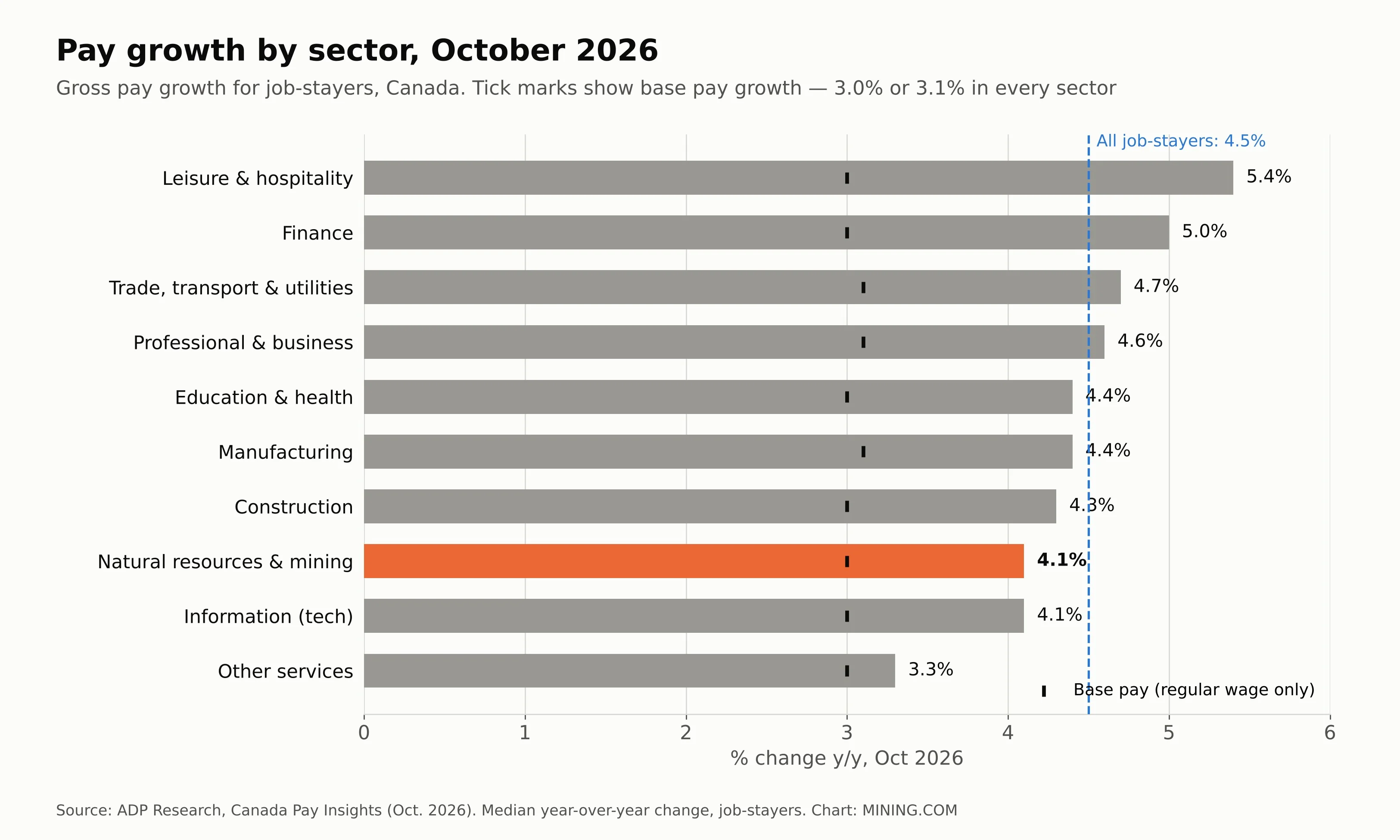
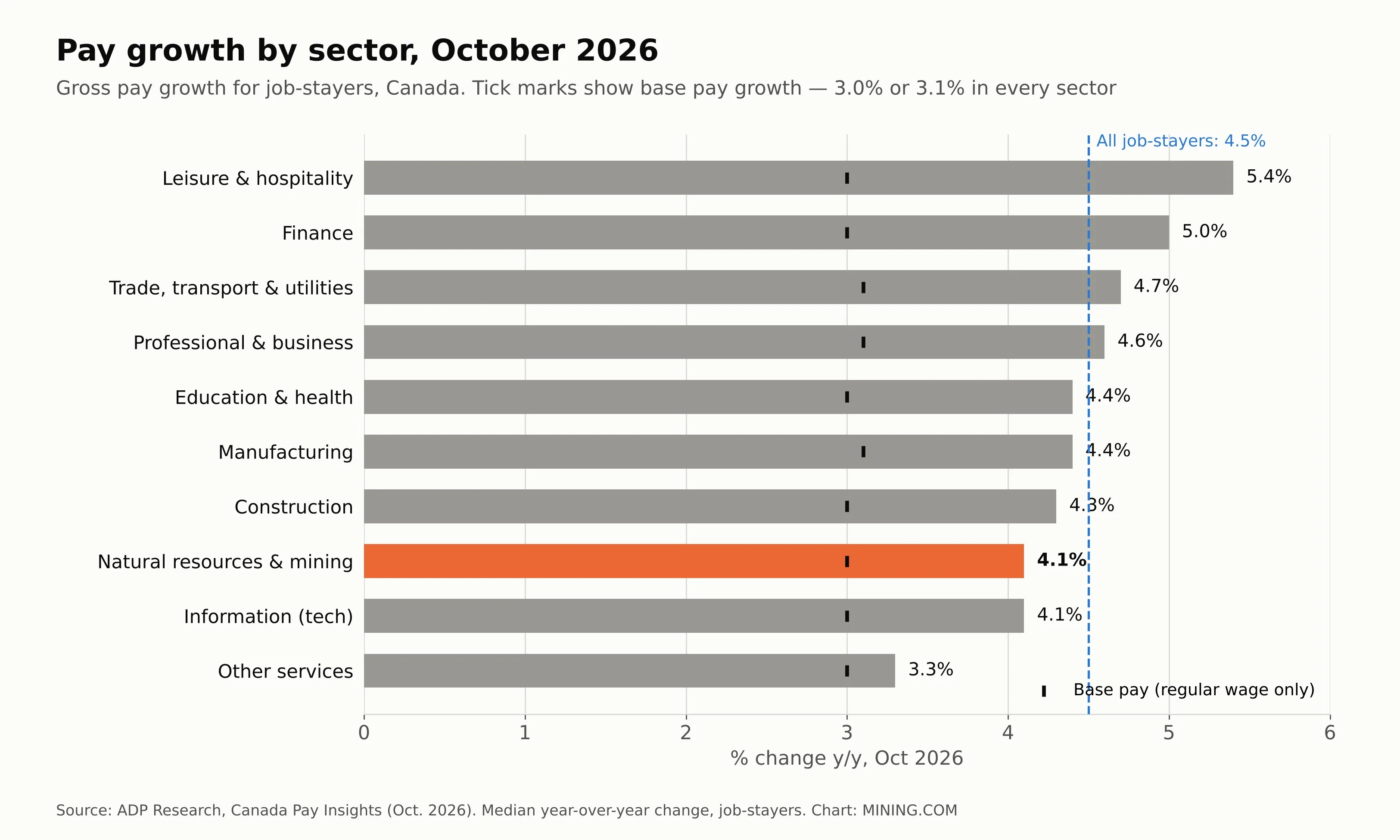
Mining is still Canada's best-paid sector by a wide margin. The catch is what happens if you stay put. New payroll data from ADP Canada, based on roughly 1.6 million private-sector paycheques, shows gross pay for job-stayers in natural resources and mining rose 4.1% year over year in October. That's unchanged from September, tied for eighth of the ten sectors ADP tracks, and well below the 4.5% national figure for job-stayers.
Only other services, at 3.3%, did worse. Finance led at 5.0%. Information, the closest the dataset gets to tech, also came in at 4.1%, though that category includes journalists. Tech may be feeling early effects from AI use, especially in junior roles, but this dataset can't isolate that.
Statistics Canada's payroll survey, which runs two months behind ADP, puts average weekly earnings in mining, quarrying and oil and gas at C$2,584 in August. The all-industry average is C$1,355, and accommodation and food services sits at C$531. A 4.1% raise on the mining average works out to roughly C$106 a week. Yet StatCan shows weekly earnings in the sector up just 0.8% year over year, while the all-industry figure rose 3.7%.
Naturally volatile
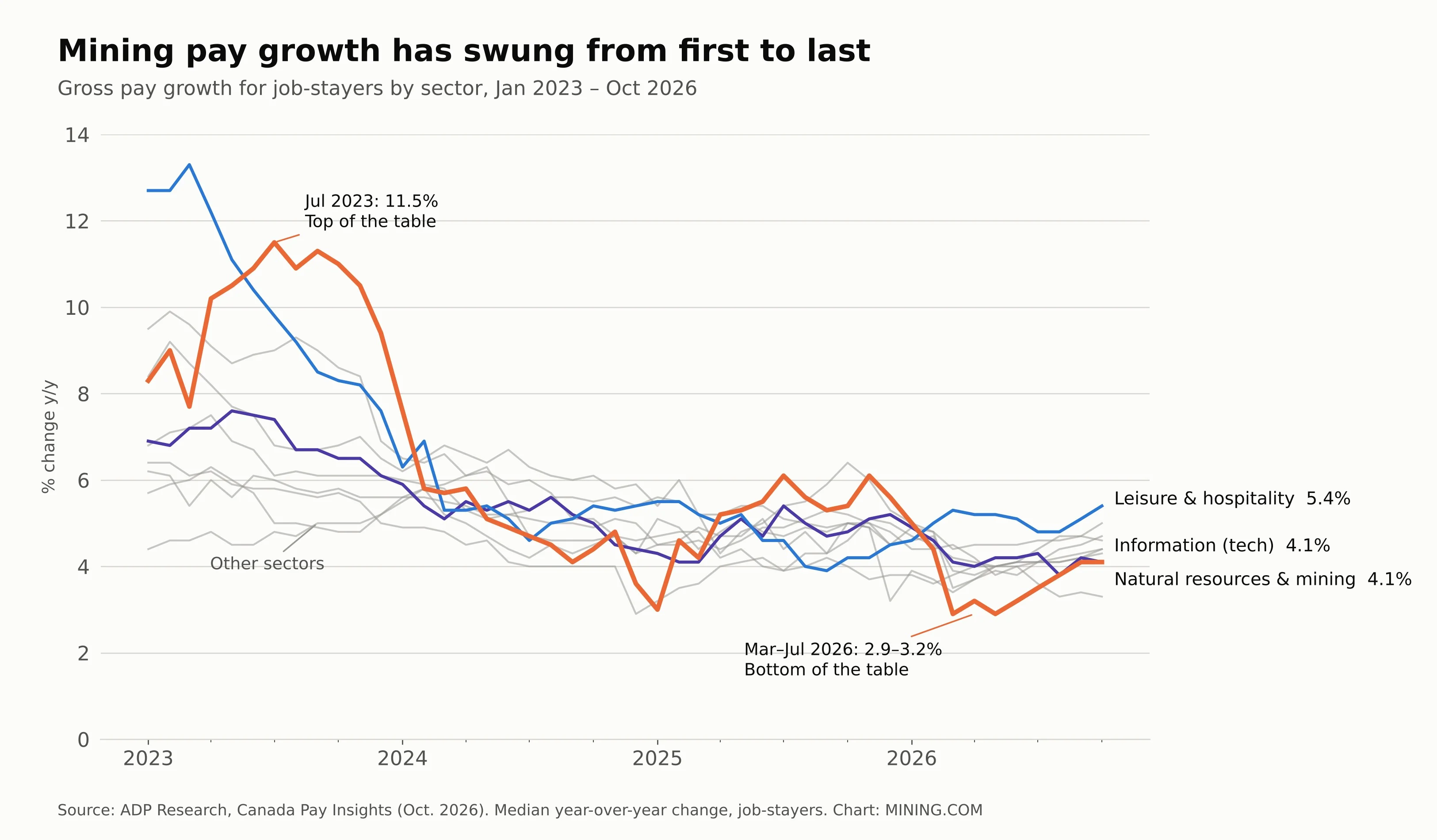
Natural resources and mining, which in ADP's grouping is mainly oil and gas plus some agriculture and forestry, has been the most volatile pay sector in the country over the past three years. Its monthly readings swing roughly four times as much as manufacturing's, measured by standard deviation. In July 2023, gross pay growth hit 11.5%, and the sector held the top spot for eight straight months. By March 2026, it had dropped to 2.9%, the lowest of any sector, and stayed there for five months.
Manufacturing's entire four-year range fits within 2.4 percentage points. Mining's spans 8.6. Commodity prices probably explain much of that gap, since pay in this sector tracks the boom-and-bust cycle more closely than anywhere else.
The onus is on bonus
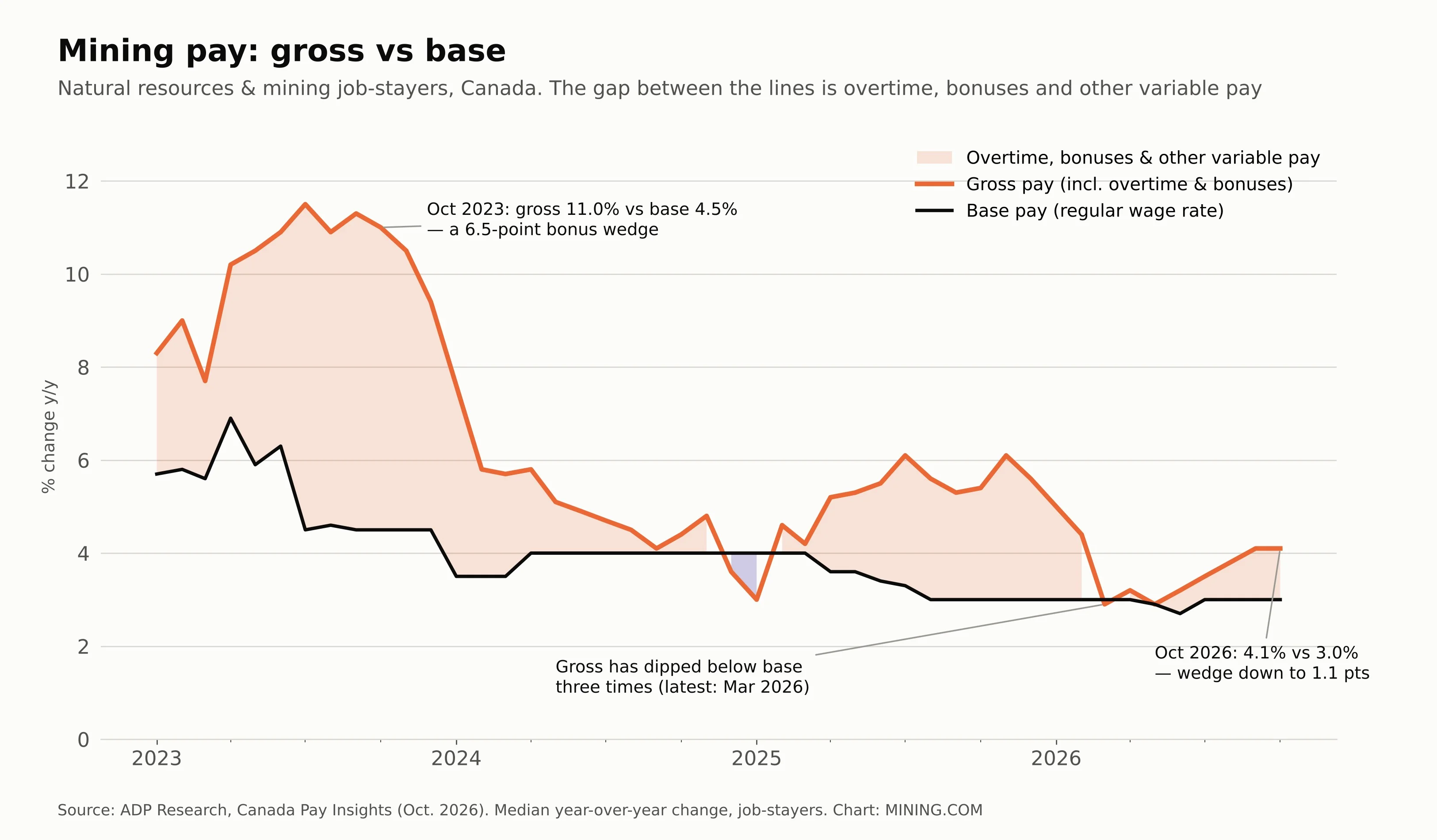
Base pay, meaning the hourly rate or salary before overtime, bonuses and commissions, is rising 3.0% for mining job-stayers. So is base pay in every other sector, with all ten landing at 3.0% or 3.1%. ADP's technical notes point to employers favouring round-number raises, and after the 2022 and 2023 inflation spike, three has become the default.
That's close to Canada's latest inflation rate of 3.1%, so base pay roughly keeps up with prices on paper. It doesn't cover everything people spend on. In September, gasoline cost 27.8% more than a year earlier and airfares were 19.4% higher. Alcohol, tobacco and cannabis rose just 1.6%.
Here's the thing: mining's pay swings come from bonuses and overtime. In October 2023, gross pay growth of 11.0% ran 6.5 points ahead of base pay growth of 4.5%, a gap no other sector came close to matching. In October 2026, the wedge has narrowed to 1.1 points. It has turned negative three times in two years, most recently in March.
Compounding the cycle
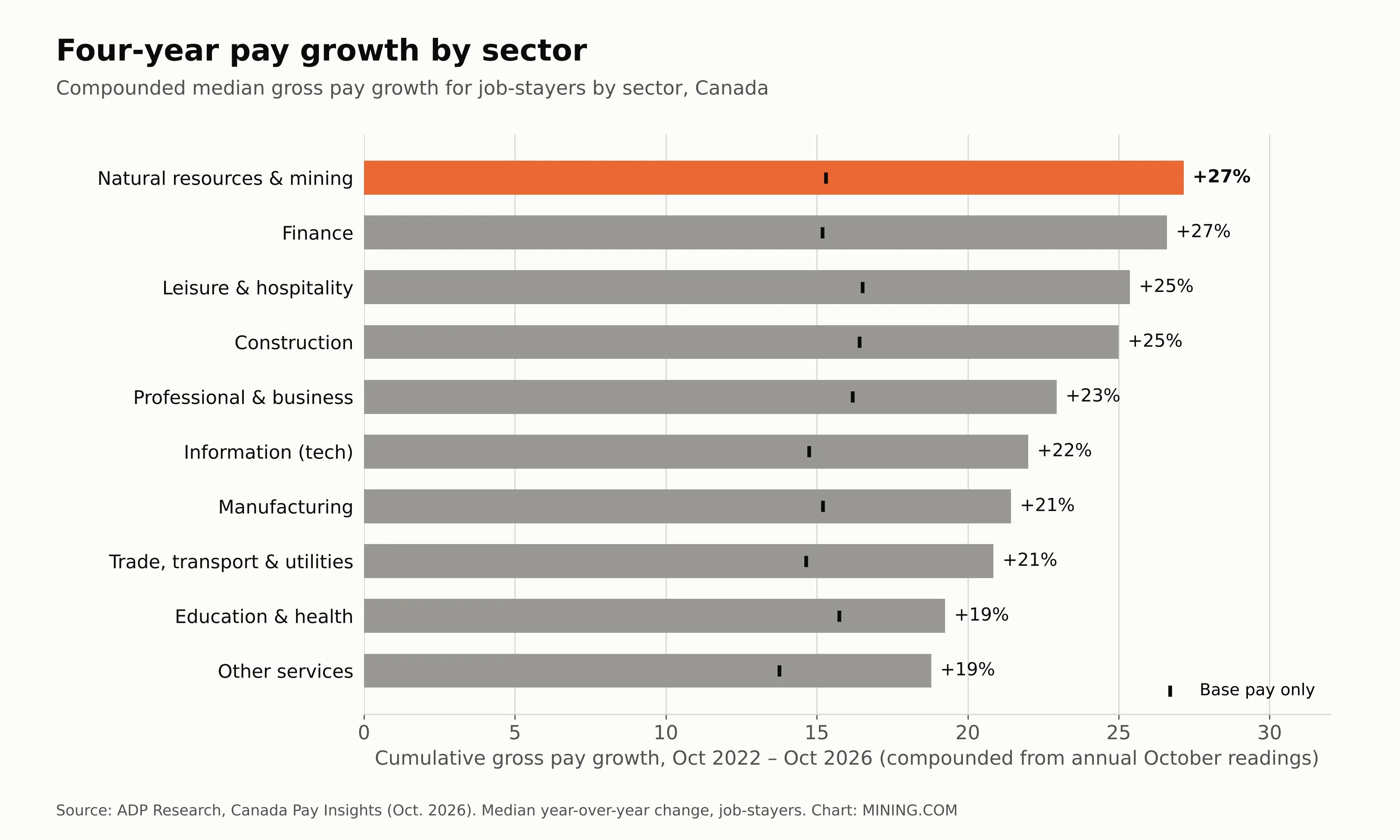
Compound the October readings from 2023 through 2026, and mining job-stayers have seen gross pay rise about 27% since October 2022, the base month of ADP's Canadian series. That's the highest of any sector, but only narrowly ahead of finance and leisure, and well above the roughly 22% for job-stayers nationally. Most of that lead comes from one year. The 11% reading in October 2023 did most of the lifting. By this measure, the best time to be a miner on a fixed payroll was three years ago, the second-best was last summer, and the worst was this spring.
Loyalty pays less than switching
ADP doesn't break out job-switching by sector. My read is that moving between two remote mine sites is a smaller leap than changing industries, but the data can't confirm that. Nationally, job-changers saw gross pay rise 10.4% in October, against 4.5% for stayers. That 5.9-point premium is the widest since February 2024, and it's wider than a year ago, when switchers' raises bottomed at 7.1%. Base pay shows the same split: 6.0% for changers, 3.0% for stayers.
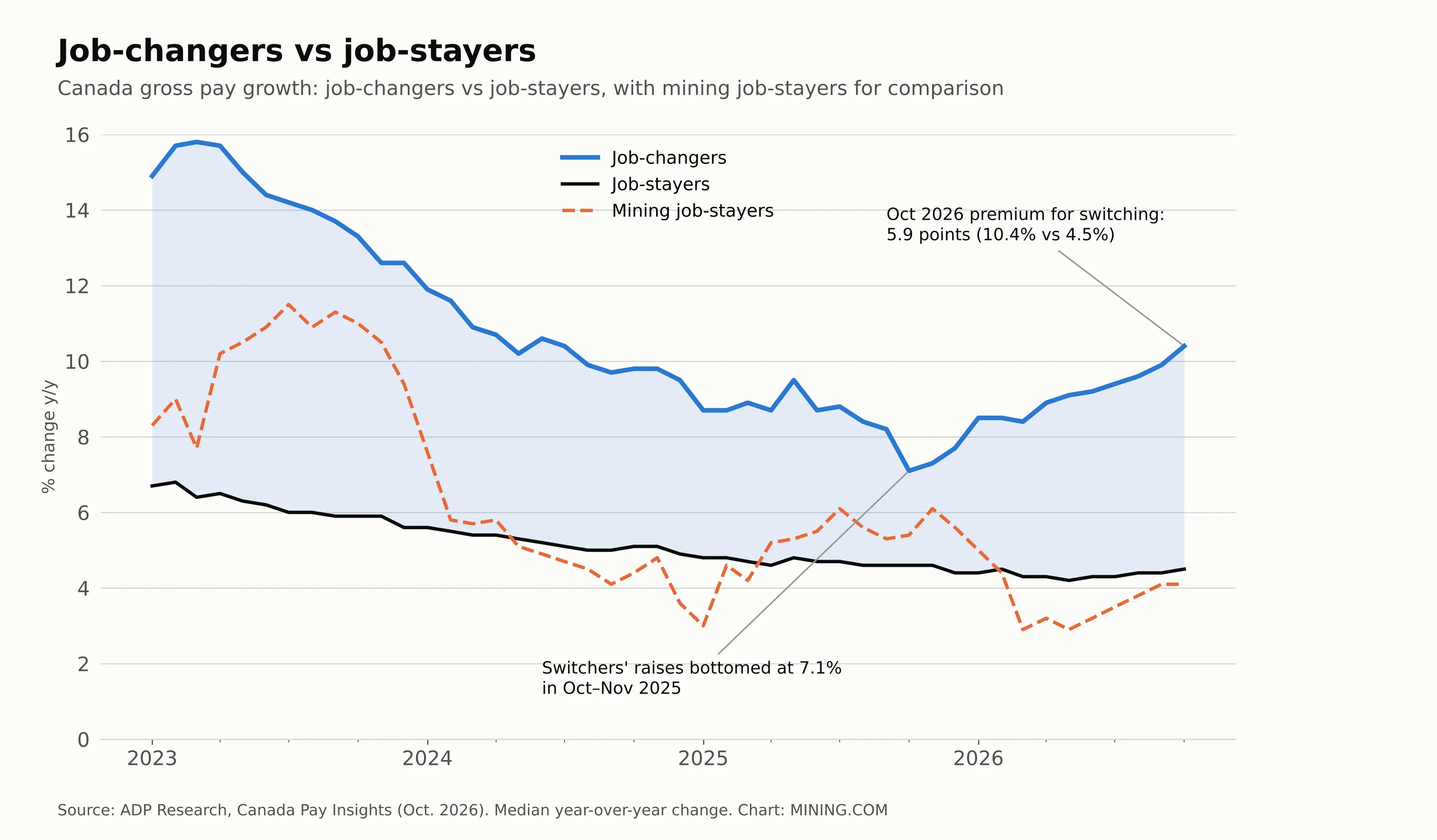
If the market is paying switchers around 10%, staying put starts to look like a slow grind, especially for mid-career workers. Among job-stayers across the economy, those aged 35 to 54 saw gross pay rise 4.4% in October, in line with the national average. Workers over 55 got 2.9%. Stayers under 25, at 10.5%, matched the pace of switchers, which is the usual early-career ramp.
Mining is still hiring. StatCan's payroll count for mining, quarrying and oil and gas rose 3.9% year over year to 226,600, the fastest growth among the 20 sectors it tracks. Overall payroll employment grew only 0.3%. Demand for workers is there. The open question is whether pay for people who stay keeps pace with what the market is paying everyone else.
Discussion
Sign in to join the discussion.