GEM Mining Consulting sees Argentina overtaking Chile as South America's top lithium producer by 2035, a lead that hinges on one project.
A lead that hangs on one project
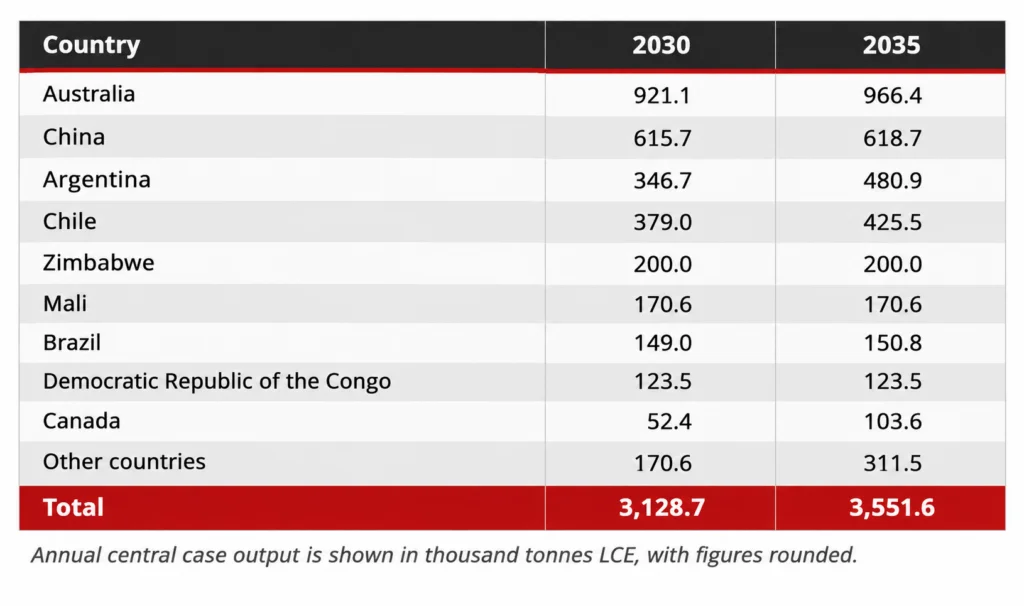
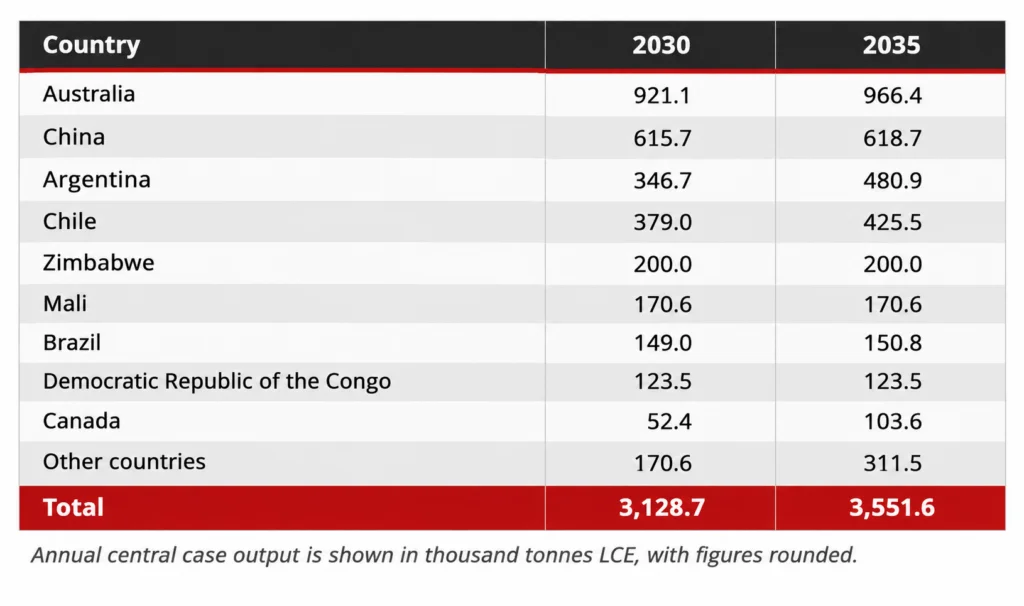
Argentina's lead over Chile in South American lithium output by 2035 rests on a single project. GEM Mining Consulting puts Argentina at 481,000 tonnes LCE that year, just ahead of Chile's 426,000 tonnes. That's a gap of roughly 55,000 tonnes, which sounds comfortable until you see how little it takes to erase it.
Remove one development from the model, though, and Argentina drops to about 391,000 tonnes, falling behind its western neighbour. The gap between the two scenarios is about 90,000 tonnes, the same size as the project being removed. Models like this often produce rankings that look decisive at the top and fragile underneath, and this is a clean example.
That makes the Pozuelos–Pastos Grandes project the swing factor. The two-stage build is expected to contribute 90,000 tonnes LCE a year, and the ranking depends on it arriving on schedule. (And this is the part most people overlook.) Timing matters as much as existence. A project that arrives two years late can look identical to one that never arrives, at least for any single forecast year. Lithium projects of this type routinely run behind on financing, permitting and construction, so a fixed schedule is an assumption, not a fact.
Chile still grows in the forecast, from roughly 361,000 tonnes in 2026 to 426,000 tonnes in 2035. Its share of modelled global supply nonetheless slides from about 18% to 12%. That's not a Chilean contraction. It's Argentina, Mali, Brazil and Canada expanding faster, and the market share math reflects that. Growing in absolute terms while losing ground in relative terms is what happens when the pie gets much bigger around you. I'd flag that for anyone reading the headline: a falling share says more about competitors than about Chilean operations.
The wider supply picture
The study's central case has global lithium supply reaching 3.13 million tonnes LCE in 2030 and 3.55 million tonnes in 2035. Australia stays the largest producer at about 966,000 tonnes, with China next at 619,000 tonnes. The model draws on 150 operating mines, expansions and development projects across 27 countries.
Those totals are the baseline everything else gets measured against. Growth from 3.13 million to 3.55 million tonnes over five years is about 420,000 tonnes, a steady climb that only materialises if the whole pipeline moves at once. A model covering 150 operations in 27 countries is broad by design, which helps you spot patterns. It also means any single country's ranking hinges on a small number of decisions.
Execution is the real variable
The scenarios show how far the outlook can move. A constrained development path with weaker operating results lands at just 2.63 million tonnes LCE by 2035. Faster project delivery pushes output to 4.03 million tonnes. That spread is wider than most of the rankings debate, and it's driven by whether projects get financed, commissioned and run well.
Put another way, the gap between the best and worst cases is about 1.4 million tonnes, roughly 40% of the central case. That's far larger than the Argentina–Chile difference that's drawing the headlines. Yet the ranking story gets more airtime, probably because a country-by-country table is easier to read than a range of outcomes.
A weaker market adds another layer. In that case, new developments slip two years and existing operations cut output by 10% starting in 2027. Projected 2030 supply falls by about 529,000 tonnes, or 17%, against the central case. Delays and cuts like these tend to arrive together in a downturn, since weak prices stall financing and squeeze margins at the same time. That combination is what makes scenario planning uncomfortable.
Here's the thing: announced capacity isn't the same as delivered tonnes. Financing gaps and construction delays can reshuffle the top of the table quickly, and a country's lead on paper can disappear once a flagship project slips. Treat any single ranking as a snapshot of assumptions, not a forecast you can bank on.
What this means if you're watching the market
For buyers, GEM recommends tying contracted volumes to verifiable milestones, including secured financing, commissioning and sustained recovery performance. It also argues that diversification should look past mine locations to processing capacity and transport routes. Those are the constraints that will decide which suppliers can actually meet long-term commitments. A mine in a strong jurisdiction still delivers nothing if the refinery or the export route is the bottleneck.
If you're tracking this space, the useful question isn't who leads in 2035 on paper. It's which projects have financing you can verify and commissioning dates you can check against actual progress. Not a forecast. A set of tests you can apply as new information arrives.
The Argentina–Chile contest will likely keep drawing attention because it's easy to summarise in a headline. The underlying story is less tidy. A single project decides the ranking, the wider range swings far more than that ranking does, and the outcome depends on execution rather than announced capacity. That's the part worth watching.
Discussion
Sign in to join the discussion.