Foreclosure filings soared over 10% in July, particularly in Texas and Florida, creating new challenges and opportunities for lenders focusing on loss mitigation.
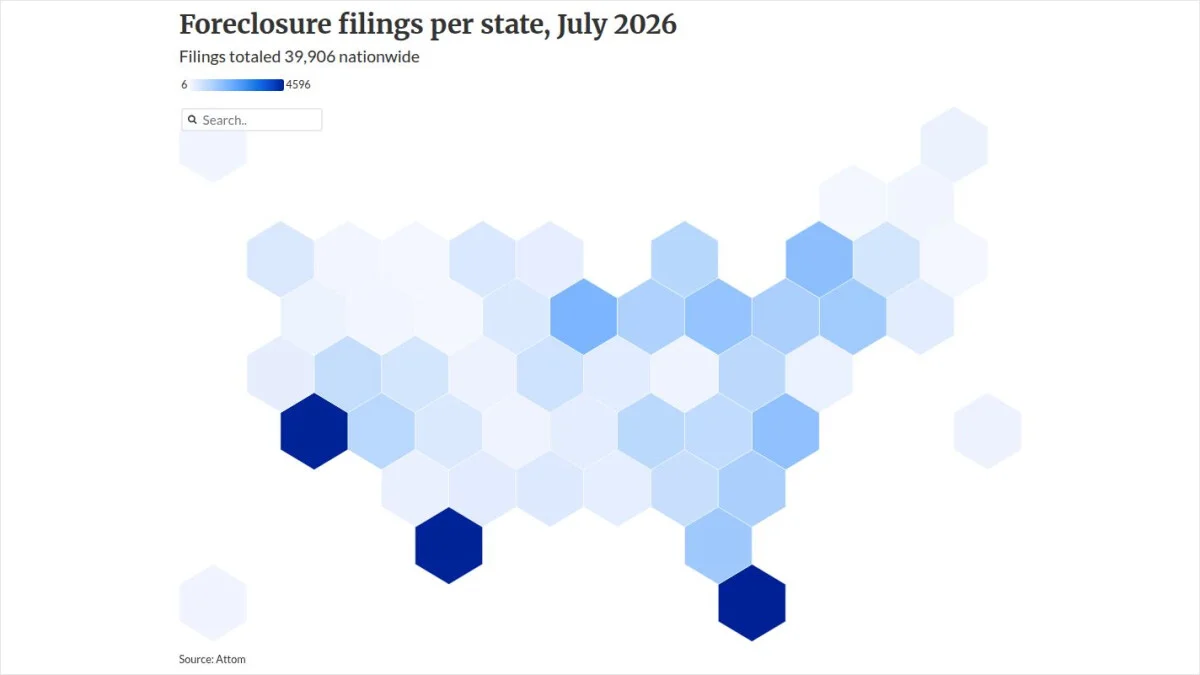
Recent data from Attom reveals a significant rise in foreclosure activity across the Sun Belt, with filings in July increasing by over 10% year-over-year. This trend is particularly pronounced in Texas and Florida, which are at the forefront of both new foreclosure starts and completed bank repossessions. For lenders, this scenario underscores the immediate necessity to enhance regional default servicing capabilities and implement targeted loss mitigation strategies to navigate rising credit risks.
Year-Over-Year Trends in Foreclosure Activity
While July's foreclosure count indicates an uptick compared to the previous year, it also signals a return to normalcy in the long-term foreclosure trends. As per Attom’s findings, foreclosure notices—which include new filings, scheduled auctions, and completed repossessions—rose by 10.4% compared to the same month last year, reaching a total of 39,906 properties, or one in every 3,603 housing units across the U.S. This contrasts with a year ago, when there were around 36,128 foreclosures, equating to one in 3,939 homes. What this means for the housing market is that we aren't necessarily in crisis mode, but rather seeing a normalization. The market had been buoyed by pandemic-related forbearances, so a rise in foreclosures shouldn’t be dismissed hastily as a disaster.
New lender foreclosure notices were issued for 26,648 homes in July, marking a 9.6% increase from July 2025’s 24,302 notices. This count also reflects a 1.6% rise from the 26,217 notices a month prior. Here’s the thing: the month-to-month rise could indicate a shift in loan performance as more homeowners find themselves unable to keep up with payments, but let’s also consider that this could be a temporary blip. It’s a situation that cries out for careful examination; rising notices could either signal a distressed market or merely a return to pre-pandemic norms.
Complete real estate-owned (REO) foreclosures held steady at 4,764 units, only marginally below June's figure of 4,773. Yet, this year's completed foreclosures represent a striking 23.2% increase from 3,866 in July 2025. Rob Barber, CEO of Attom, commented on the ongoing financial pressures facing some homeowners, highlighting the mixed signals in current foreclosure data. He noted, "While annual increases have become more common, current volumes indicate that the market remains relatively resilient overall." It’s a perspective worth considering; the apparent spikes in data could coalesce into a narrative of economic resilience rather than desperation, if the broader economy holds stable.
Month-to-month changes in foreclosure activity may hint at an improvement in homeowner finances, particularly in light of recent delinquency trends. Reports from both the Intercontinental Exchange and the Mortgage Bankers Association indicate a reduction in early-stage delinquencies over the spring and summer. Still, stress levels remain elevated when juxtaposed with last year’s figures. If you're working in this space, this means the market is complex and nuanced; rising foreclosures don't tell the whole story.
Identifying the Affected Areas
Nevada recorded the highest foreclosure rate nationwide, with one in every 1,703 housing units under distress in July. South Carolina and Florida followed, with rates of one in 2,085 and one in 2,232 properties, respectively. Among the states, Texas led the charge in new foreclosure initiations, with 3,306 filings. Florida was close behind, reporting 3,277 new starts, while California had the third most with 2,540. This regional disparity is crucial for understanding where lenders may need to concentrate their risk management efforts.
Moreover, Texas topped the nation in completed REO repossessions, with banks assuming ownership of 1,265 residences last month. California trailed with 616 repossessions, followed closely by North Carolina at 299. Major cities like Houston and Dallas dominated the foreclosure completion metrics, registering 405 and 223 respectively. (and this is the part most people overlook) The geographic concentration of these foreclosures has implications for both state and local economies, influencing everything from job markets to housing prices.
Implications for Lenders and the Housing Market
This surge in foreclosures serves as a double-edged sword for lenders, who must balance between managing growing default risks and harnessing the opportunity presented by an evolving market. Increasing foreclosures can spur lenders to refine their outlook and improve collection practices, but they must also consider the impacts these actions may have on the broader economy. Lack of strategic planning could lead to a backlash, as communities may face declines in property values or issues related to vacant homes.
What's the long-term implication of these trends? If rising foreclosures persist, lenders that fail to adapt could find themselves facing not just a rise in defaults but also reputational damage. On the flip side, those who proactively engage with distressed borrowers and refine their loss mitigation strategies may find opportunities to stabilize their portfolios. The question remains: will lenders take this moment to innovate, or will they retreat into traditional methods that no longer serve today’s realities? The answers could reshape the market significantly in the years to come.
Discussion
Sign in to join the discussion.